
Advancing South India’s Global Agenda

Creativity as Capital: Orange Economy in South India: Balasubramanian Chandrashekar
BackCreativity as Capital: Orange Economy in South India: Balasubramanian Chandrashekar
Issue Brief No: 02
Creativity as Capital: Orange Economy in South India
Author: Balasubramanian Chandrashekar
Orange Economy in India’s Union Budget 2026
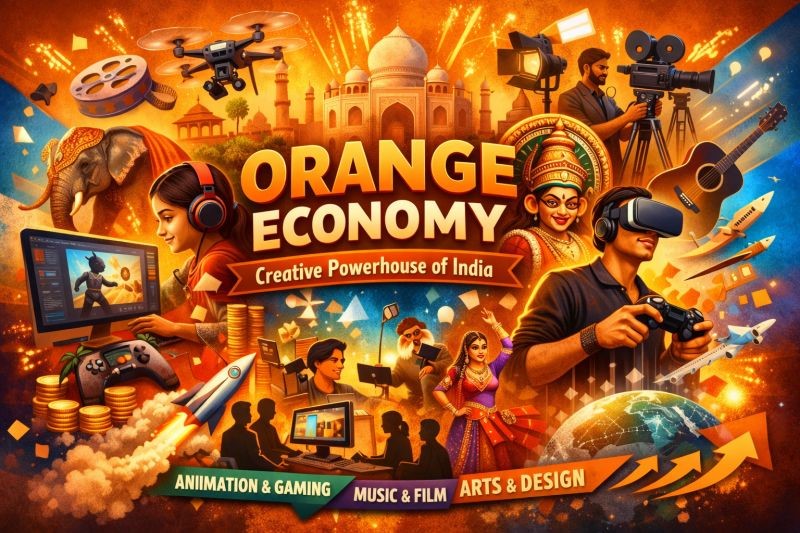
In the Union Budget 2026, Finance Minister Nirmala Sitharaman highlighted the Orange Economy (also known as the Creative Economy), recognising its critical role in employment generation, innovation, exports, and soft power. The Orange Economy is fundamentally about turning creativity into income—where ideas themselves generate economic value.
India’s Orange Economy encompasses media, arts, design, content creation, film, music, animation, visual effects (VFX), gaming, comics (AVGC), OTT platforms, architecture, publishing, and other sectors that rely on creativity, knowledge, and intellectual property (IP) to create economic value. It thrives on innovation, strong IP protection, digital platforms such as streaming services, and cultural exports—including Bollywood, yoga, and Indian cuisine—that enhance India’s global influence.
WAVES 2025
The term gained prominence in India when Prime Minister Narendra Modi emphasised the country’s rising role in the global creative economy during the WAVES 2025 summit (World Audio Visual and Entertainment Summit), held at the Jio World Convention Centre in Mumbai. Organised by the Government of India, WAVES 2025 aimed to position India as a global hub for media and entertainment, intellectual property, and technological innovation, showcasing strengths in content creation and technology across broadcasting, films, animation, gaming, digital media, artificial intelligence, and related fields.
A New Growth Paradigm
Globally, the creative economy generates over $2 trillion in annual revenue and supports nearly 50 million jobs. According to UNCTAD estimates, creative industries contribute between 0.5% and more than 7% of GDP across different countries.
In India, the creative sector is currently valued at approximately $30 billion and employs roughly 8% of the working population. The sector is poised for significant growth over the next five years. India also ranks third globally in the number of creative startups.
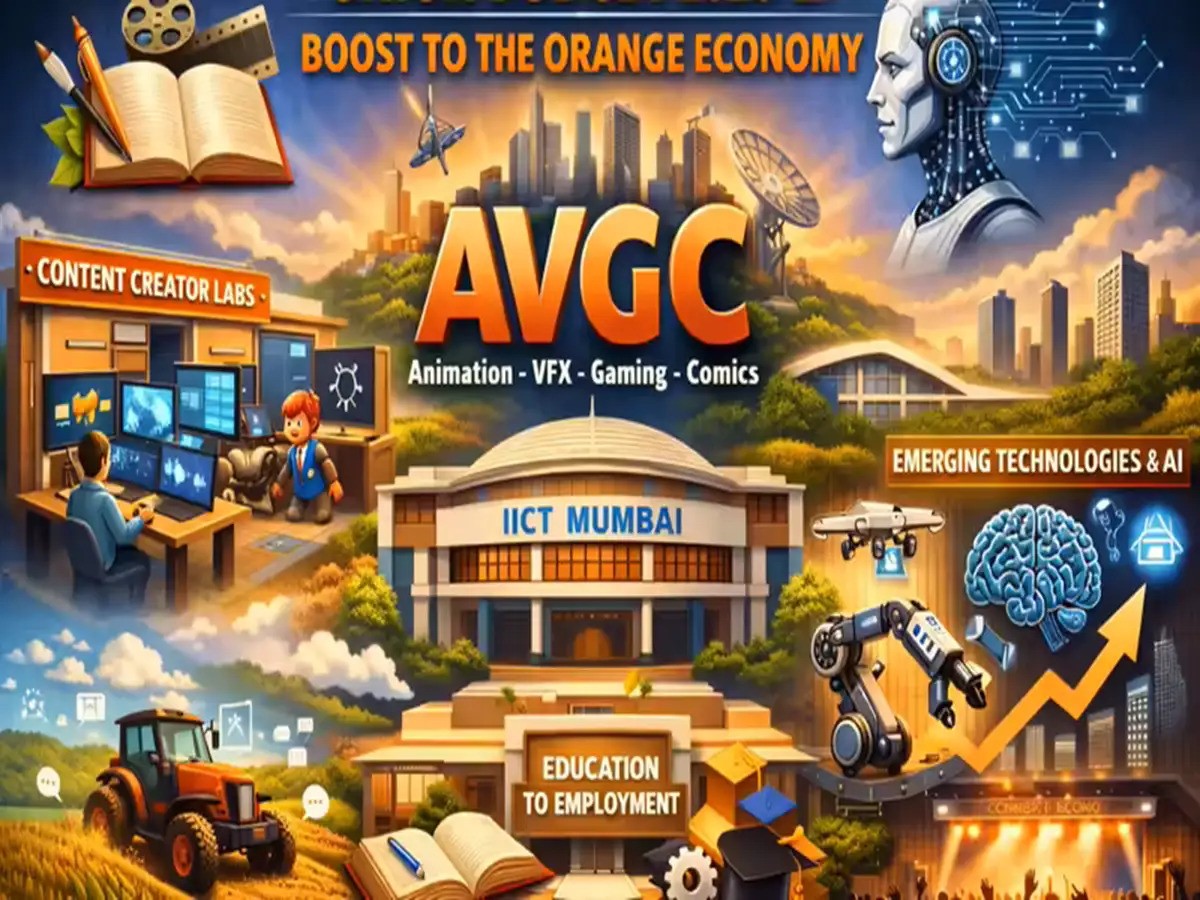
The 2026 Budget proposes establishing AVGC Content Creator Labs in 15,000 secondary schools and 500 colleges, supported by the Indian Institute of Creative Technologies (IICT), Mumbai, to build skills in animation, VFX, gaming, and comics.
Unlike traditional manufacturing-led growth, the Orange Economy derives its primary value from ideas, artistic expression, and cultural capital rather than physical goods. The term “Orange Economy” was originally coined by former Colombian President Iván Duque Márquez and Felipe Buitrago in their 2013 book, The Orange Economy: An Infinite Opportunity.
Global Status
South Korea
South Korea deliberately adopted the creative economy as a national growth strategy after the 1997 Asian Financial Crisis, recognising culture as a strategic export it was called the “Hallyu (Korean Wave) Model”.
South Korea’s Ministry of Culture, Sports and Tourism (MCST) as a nodal agency made steady but heavy state investment in K-Pop, K-Drama, Films; Gaming and Animation with Strong copyright enforcement and global licensing. It also did Export-oriented content strategy via: Netflix, YouTube, Spotify; integrating culture with technology and branding. The outcomes were Hallyu exports exceed $12 billion annually; BTS alone contributes $5 billion/year to GDP; today South Korea ranks among the top 5 global gaming markets and tourism surge driven by pop culture.
Japan
Japan is widely recognised for its pioneering “Cool Japan” strategy, launched to globalise its distinctive cultural products and help counter prolonged economic stagnation. The initiative deliberately positions Japanese creativity and lifestyle as valuable soft-power assets on the world stage.
The strategy places strong emphasis on several high-impact cultural domains. Anime, manga, and video gaming form the core pillars, supported by equally important areas such as fashion, traditional and contemporary cuisine (notably ‘washoku’, recognised by UNESCO), artisanal crafts, and other elements of Japanese design and aesthetics. Cultural tourism and national branding also receive significant attention, with efforts to integrate these creative sectors into broader visitor experiences and international perception.
Japan has built a robust institutional framework to support the Cool Japan vision. The Cool Japan Fund, a public-private investment vehicle, provides financing to promising projects and companies in creative industries. Global promotion is achieved through a variety of channels, including large-scale cultural festivals abroad, strategic international collaborations, and deliberate integration of Japanese culture into tourism campaigns and retail experiences worldwide.
The outcomes of the Cool Japan strategy have been substantial. The anime industry alone is valued at approximately $20 billion. Japan consistently ranks among the world’s leading exporters of cultural goods. The country has cultivated an enormous and devoted global fandom for its pop culture, spanning multiple generations and continents. At the same time, cultural branding has played a major role in driving a significant rise in inbound tourism, with many international visitors drawn specifically by Japan’s creative and lifestyle appeal.
United Kingdom
The United Kingdom stands as one of the earliest adopters of the creative industries framework, having officially recognised the sector as early as the 1990s. The country has implemented several key policy tools to support and grow this sector. Among the most important is the Creative Industries Sector Deal, which fosters collaboration between government and industry. The UK also offers attractive tax incentives specifically targeting high-value creative sub-sectors such as films, animation, visual effects (VFX), and video games. Complementing these measures are robust intellectual property (IP) laws and strong enforcement mechanisms that protect creators and encourage investment in original content and innovation.
A defining feature of the UK’s approach has been the deliberate development of creative clusters across the country. London serves as the powerhouse for media and advertising, while Manchester has emerged as a major centre for gaming and television production. Bristol, meanwhile, has built a strong reputation in animation. These geographic concentrations are further strengthened by close linkages between academia and industry, enabling talent development, research collaboration, and the rapid translation of ideas into commercial success.
The results of these sustained efforts are impressive. The creative industries contribute £125 billion to the UK’s GDP and provide employment to over 2.3 million people. The country has also established itself as Europe’s largest exporter of creative services. Above all, London has solidified its position as one of the world’s leading global creative hubs, attracting talent, investment, and international projects across multiple disciplines.
Opportunities South India
South India's five states—Karnataka, Tamil Nadu, Kerala, Telangana, and Andhra Pradesh—stand out due to their rich cultural heritage (classical arts, folklore, temples, festivals), established film industries, growing tech ecosystems, and handicraft traditions. These assets create unique opportunities for IP-driven growth, youth employment, exports, startups, and sustainable development in the Orange Economy.
Andhra Pradesh
Andhra Pradesh is actively positioning itself as an emerging hub for AI-driven creative technologies and next-generation media production. The state is encouraging investments in digital media, virtual production, gaming, animation, and advanced film technologies. A key player in this effort is the Andhra Pradesh VFX, Animation & Gaming Association (APVAGA), which works to strengthen the sector through policy advocacy, talent development programs, and stronger industry-academia collaboration. The state is also in the process of drafting a dedicated AVGC-XR policy to provide a structured framework for growth, incentives, and ecosystem development in animation, visual effects, gaming, comics, and extended reality.
Andhra Pradesh offers a diverse set of opportunities within the Orange Economy, many of which leverage cutting-edge technology and the state’s cultural strengths. A major focus is on AI-integrated creative technologies, including generative AI for content creation, virtual production techniques, and virtual reality applications. One prominent example is the use of VR for tourism promotion, such as immersive projects like “Discover Andhra Pradesh 360,” which allow potential visitors to experience the state’s heritage sites and landscapes virtually before traveling.
The state’s regional cinema sector presents significant potential for expansion, particularly when combined with film tourism. Andhra Pradesh’s rich cultural heritage, scenic landscapes, and historic locations provide an ideal backdrop for both production and visitor experiences, attracting filmmakers and tourists alike. Traditional handicrafts—such as Kalamkari textiles, Etikoppaka and Kondapalli wooden toys, and other GI-tagged products—also hold strong economic promise. These can be scaled through e-commerce platforms, targeted export strategies, and design collaborations that blend traditional craftsmanship with contemporary aesthetics.
Spiritual and cultural tourism remains one of Andhra Pradesh’s most powerful growth drivers, with sites like Tirupati drawing millions of visitors annually. By integrating creative storytelling, immersive digital experiences, and innovative content formats, the state can enhance these destinations, creating higher-value visitor journeys that combine devotion, culture, and technology.
Through its deliberate emphasis on youth employment in creative and technology-driven sectors, Andhra Pradesh is building a foundation for inclusive and sustainable growth. The combination of emerging AI and AVGC capabilities, a vibrant regional film industry, rich handicraft traditions, and high-potential tourism assets positions the state to become a significant contributor to India’s Orange Economy in the coming years.
Karnataka
Karnataka has established itself as a national leader in animation, visual effects, gaming, and comics (AVGC), as well as in broader digital creativity. Bengaluru, in particular, pioneered India’s AVGC sector with the country’s first dedicated policy in 2012. Today, the state continues to set the pace with the AVGC-XR Policy 3.0, which builds on earlier frameworks to attract investment, foster innovation, and position Karnataka at the forefront of extended reality (XR) and emerging creative technologies. The state is home to more than 300 studios, many of which contribute significantly to high-profile Hollywood productions, underscoring Bengaluru’s growing reputation as a global outsourcing and production hub.
Karnataka has set ambitious targets for the sector, aiming to create 50,000 high-value jobs by 2028 while aspiring to capture 20% of the global AVGC market share. These goals reflect the state’s confidence in its ability to scale rapidly, driven by a unique combination of world-class IT infrastructure and a thriving creative ecosystem.
The state offers a wide range of opportunities across multiple sub-sectors. Gaming, animation, visual effects, and extended reality (XR) development stand out as major growth areas, strengthened by the powerful synergy between Bengaluru’s IT industry and its multimedia capabilities. The Kannada film industry, popularly known as Sandalwood and producing around 200 films annually, presents significant potential for expansion into digital streaming and OTT platforms, enabling wider reach and new revenue streams. Startups focused on design, digital content, and creative technologies are also flourishing, supported by a vibrant entrepreneurial environment. In addition, skilling initiatives and the establishment of Centres of Excellence are creating pathways for talent development and positioning Karnataka as a preferred destination for global outsourcing in AVGC and related fields.
Bengaluru’s distinctive ecosystem is particularly well-suited for the fusion of technology and creativity. This convergence is driving innovation in areas such as AI-enhanced content creation, generative tools for media production, and the fast-growing esports industry, making the city an ideal launchpad for next-generation creative and tech-driven enterprises.
amil Nadu stands out as a major powerhouse in India’s film industry, with Chennai-based Kollywood ranking among the country’s top regional cinema sectors. The industry consistently produces over 150 films each year and generates substantial box-office revenues. In one recent year, Tamil films collectively grossed more than ₹1,63,115 crore (approximately US$19 billion), reflecting the scale and commercial strength of Kollywood. To sustain and expand this ecosystem, the state provides a range of fiscal incentives for regional cinema, children’s films, feature films, and documentaries, while also investing in infrastructure upgrades at M.G. Ramachandran Film City to support modern production needs.
Tamil Nadu
Tamil Nadu is now rapidly emerging as a significant player in the animation, visual effects, gaming, comics, and extended reality (AVGC-XR) space. A flagship initiative is the newly established Viyan AVGC-XR Centre of Excellence in Chennai, backed by a ₹50 crore investment. This centre is designed to create high-end jobs and foster innovation through co-working spaces, advanced production labs, and strong public-private partnerships, positioning the state to capture growing demand in animation, gaming, VFX, comics, and XR technologies.
Beyond film and digital media, Tamil Nadu offers rich opportunities rooted in its classical and traditional heritage. The state’s renowned performing arts—particularly Bharatanatyam and Carnatic music—present strong potential for digital transformation. These art forms can be adapted into high-quality digital content, online education platforms, live-streamed performances, and new models of intellectual property monetization, reaching both domestic and global audiences.
The state’s rich tradition of handicrafts and GI-tagged products, such as Kanchipuram silk sarees and Tanjore paintings, also holds significant economic promise. These can be scaled through e-commerce platforms, targeted export strategies, and value-added design collaborations, creating sustainable livelihoods while preserving cultural heritage. Cultural tourism, centred on Tamil Nadu’s iconic temples, historical sites, and living traditions, offers additional growth avenues, complemented by opportunities in fashion and design sectors that draw on the state’s artistic legacy.
Tirupur’s recognition as one of India’s top creative districts further highlights Tamil Nadu’s grassroots potential. This acknowledgment underscores the state’s ability to nurture creativity and entrepreneurship at the community level, reinforcing its position as a diverse and dynamic contributor to India’s Orange Economy.
Kerala
Kerala has earned a distinctive reputation in Indian cinema through its Mollywood industry, which produces approximately 200 films each year. Unlike many other regional industries, Malayalam cinema is widely recognised for its emphasis on quality storytelling, realistic narratives, and artistic depth. To support and strengthen this sector, the state offers a variety of fiscal incentives covering different film categories, along with targeted initiatives to promote women directors and provide platforms for lower-budget films, particularly those suited to online and digital distribution.
Kerala has taken a forward-looking step in the animation, visual effects, gaming, comics, and extended reality (AVGC-XR) space by introducing a dedicated AVGC-XR Policy in 2023. This policy is designed to attract investment, increase exports, enhance skill development, and foster innovation across the creative technology ecosystem, positioning the state as an emerging contender in high-growth digital content industries.
The opportunities in Kerala’s Orange Economy are deeply rooted in its rich cultural heritage and natural assets. The state’s Malayalam content holds significant potential for digital expansion, with growing reach on OTT platforms and international streaming services that can bring high-quality regional storytelling to global audiences. Kerala’s classical and traditional performing arts—such as Kathakali, Mohiniyattam, and Theyyam—offer powerful avenues for development. These art forms can be transformed into immersive tourism experiences, digitally archived for preservation and wider access, and adapted for international collaborations, festivals, and online content creation.
Cultural and eco-tourism remains one of Kerala’s strongest growth drivers. The state can capitalise on its iconic backwaters, Ayurveda wellness traditions, and vibrant festivals to deliver high-value, immersive visitor experiences that blend authenticity with modern expectations. At the same time, Kerala’s rich tradition of handicrafts—including coir products, bamboo crafts, wood carvings, and Kasavu textiles—presents substantial opportunities. Through strategic branding, e-commerce expansion, geographical indication (GI) protection, and targeted export initiatives, these crafts can generate sustainable livelihoods while reinforcing the state’s cultural identity in global markets.
Kerala’s deep talent pool in arts, design, media, and performing traditions gives it a unique advantage in building a comprehensive creative economy. By effectively integrating its rich cultural legacy with modern technology and digital platforms, the state is well positioned to develop a holistic Orange Economy policy that balances heritage preservation with innovation and economic growth.
Telangana
Telangana has firmly positioned Hyderabad as a major global media and entertainment hub, anchored by the Telugu film industry, popularly known as Tollywood. The industry ranks among India’s leading regional cinemas in terms of production volume, audience reach, and commercial impact. At the heart of this ecosystem is Ramoji Film City, recognised as the world’s largest film studio complex, which provides state-of-the-art facilities for large-scale film production, post-production, and related creative work. The state has actively promoted Hyderabad as a preferred destination for media and entertainment, supported by advanced infrastructure in post-production, animation, visual effects, and emerging technologies.
Telangana offers a wide range of high-potential opportunities within the Orange Economy. The state’s world-class infrastructure makes it particularly well-suited for film production, visual effects (VFX), animation, and virtual production, attracting both domestic and international projects. The powerful synergy between Hyderabad’s established IT sector and its growing creative industries creates fertile ground for innovation in gaming, digital content creation, extended reality (XR), and related technologies. This IT-creative convergence enables the development of next-generation content and interactive experiences at scale.
There are also ongoing efforts to strengthen Hyderabad’s position as a dedicated Creativity Hub. Plans include the establishment of a regional centre for creative technologies, which would further enhance skilling, research, collaboration, and investment in animation, gaming, digital media, and emerging creative fields. These initiatives aim to build a robust ecosystem that supports both established players and new entrants in the creative and technology space.
Beyond digital and media sectors, Telangana’s cultural heritage provides additional avenues for growth. Cultural tourism centred on the state’s rich heritage sites, historical monuments, and vibrant festivals offers significant potential for immersive visitor experiences. At the same time, traditional handicrafts such as Bidriware metalwork and Pochampally ikat textiles hold strong promise for global markets. Through strategic branding, e-commerce, export promotion, and design-led value addition, these crafts can generate sustainable livelihoods while contributing to Telangana’s cultural soft power.
The unique blend of world-class film studios, advanced production infrastructure, and a thriving technology ecosystem positions Telangana exceptionally well for large-scale content creation, intellectual property development, and innovation across the Orange Economy. This combination enables the state to capitalise on both its established strengths in cinema and its rapidly expanding capabilities in digital and creative technologies.
South India’s Creative Future: Can the Orange Economy Become the Next Growth Engine?
South India stands at a pivotal moment in its economic evolution.
A robust support from academic institutions across India is essential. Academic institutions across India must receive dedicated funding, infrastructure, and curriculum support to serve as the backbone of the Orange Economy. The Union Budget 2026–27 proposal for AVGC Content Creator Labs in 15,000 schools and 500 colleges through the Indian Institute of Creative Technologies (IICT) is a strong start. States should expand this by establishing specialized creative technology departments, offering degree/diploma programs in AVGC-XR, and fostering industry-academia partnerships to produce the projected 2 million skilled professionals needed by 2030.
While the Orange Economy has strong urban roots—driven by media hubs, tech clusters, digital platforms, and export-oriented AVGC production in cities like Bengaluru, Chennai, Hyderabad, and Mumbai—it is not exclusively an urban phenomenon. Traditional elements such as handicrafts, performing arts, and cultural tourism draw heavily from rural and semi-urban areas, where grassroots creativity, GI-tagged products, and heritage-based livelihoods thrive. Government efforts to integrate creative skills into schools and colleges nationwide, including non-metro and rural regions, signal an intent to democratize access and create inclusive opportunities beyond urban centres. Policymakers should promote digital skilling programs, mobile creator labs, and e-commerce platforms be prioritized in non-metro regions to ensure inclusive job creation and prevent the sector from remaining an exclusively urban phenomenon.
The government should continue playing a catalytic role through policies, fiscal incentives, skilling investments, and infrastructure (as demonstrated in state AVGC-XR policies and the 2026 Budget). At the same time, the private sector must lead in innovation, investment, and market expansion. A hybrid model—where government provides enabling frameworks and seed funding, while private studios, OTT platforms, and startups drive revenue and scale—is recommended for sustainable, market-driven growth.
A vibrant academic ecosystem actively supporting this growth is the need of the hour. Beyond IICT as a national hub (modelled on IITs/IIMs with industry-academia partnerships), specialized institutions, private training centres, and university programs in AVGC-XR, animation, gaming, and design must be expanded across states. State-level policies in South India should further encourage collaborations between academia and industry to foster research, innovation, and talent pipelines.
The question now is no longer whether South India has the ingredients for creativity-driven growth—it clearly does—but whether it can convert this potential into sustained, large-scale economic impact in the coming years. Success will depend on continued policy execution, deeper industry-academia collaboration, robust skilling initiatives, strong IP protection, and the ability to scale traditional crafts and cultural assets through digital platforms and global markets. If these states can effectively bridge tradition with innovation and turn ideas into high-value jobs, exports, and soft power, the Orange Economy could indeed become South India’s next major growth engine—delivering inclusive prosperity and reinforcing the region’s influence on both the national and global stage. The coming decade will reveal whether this vision fully materializes.
*****
References
- Department of Electronics, IT, BT and Science & Technology, Government of Karnataka. (2024). Karnataka AVGC-XR Policy 2024–2029.
https://eitbt.karnataka.gov.in/avgc/public/policy/en - Department of Electronics, IT, BT and Science & Technology, Government of Karnataka. (2024). AVGC-XR Policy operational guidelines & resources.
https://eitbt.karnataka.gov.in/avgc/public/en - Kerala State IT Mission, Government of Kerala. (2024). AVGC-XR Policy 2024 (Malayalam and English versions), with approved G.O.
https://itmission.kerala.gov.in/news/avgc-xr-policy-2024malayalamand-english-versions-approved-go - Government of Kerala. (2026). Kerala budget speech 2026-2027. Finance Department.
https://finance.kerala.gov.in/includeWeb/fileViewer.jsp?dId=d6wd6wa9zh2sg3t - Press Information Bureau, Government of India. (2025, May 4). WAVES 2025: A people's movement that empowers every creator to be a star [Press release].
https://www.pib.gov.in/PressReleasePage.aspx?PRID=2126844 - Press Information Bureau, Government of India. (2025, April 28). WAVES 2025: The ultimate global exhibition for media, entertainment, and technology [Press release].
https://www.pib.gov.in/PressReleasePage.aspx?PRID=2124892 - The Economic Times. (2026, February 1). Budget 2026: What is 'Orange Economy', why the government is backing animation, gaming, VFX, comics and how is it linked to content creators?
https://m.economictimes.com/news/new-updates/budget-2026-what-is-orange-economy-why-the-government-is-backing-animation-gaming-vfx-comics-and-how-is-it-linked-to-content-creators/articleshow/127840890.cms - (2026, February 1). 'Orange Economy' boost: Budget proposes content creator labs in institutes.
https://www.ndtv.com/india-news/union-budget-2026-live-orange-economy-boost-for-animation-visual-effects-gaming-comics-budget-proposes-content-creator-labs-in-institutes-10923982 - Times of India. (2026, February 1). Budget 2026: Govt backs 'orange economy' with focus on AVGC, content creator labs.
https://timesofindia.indiatimes.com/business/india-business/budget-2026-govt-backs-orange-economy-with-focus-on-avgc-content-creator-labs/articleshow/127836878.cms - The Hindu. (2025, May 27). Andhra Pradesh govt. working on new policy to tap potential in gaming, animation industry.
https://www.thehindu.com/news/cities/Visakhapatnam/state-working-on-new-avgc-xr-policy-aims-to-attract-hollywood-studios/article69622402.ece - India Brand Equity Foundation (IBEF). (2025). Reimagining India's creative economy for a digital future.
https://www.ibef.org/blogs/reimagining-india-s-creative-economy-for-a-digital-future - United Nations Conference on Trade and Development (UNCTAD). (2024). Creative Economy Outlook 2024.
https://unctad.org/publication/creative-economy-outlook-2024 - Buitrago Restrepo, P. F., & Duque Márquez, I. (2013). The orange economy: An infinite opportunity. Inter-American Development Bank.
https://publications.iadb.org/en/orange-economy-infinite-opportunity - Government of India, Ministry of Information and Broadcasting. (2025, May 1). Prime Minister Shri Narendra Modi inaugurates WAVES 2025 [Press release]. Ministry of External Affairs.
https://www.mea.gov.in/press-releases.htm?dtl/39455/Prime+Minister+Shri+Narendra+Modi+inaugurates+WAVES+2025 - Government of India, Press Information Bureau. (2025, May 4). WAVES 2025: A people's movement that empowers every creator to be a star [Press release].
https://www.pib.gov.in/PressReleasePage.aspx?PRID=2126844 - Press Information Bureau. (2026, February). Union Budget 2026–27: Highlights (as reported in official budget documents and FM speech). Government of India.
- Sitharaman, N. (2026, February 1). Union Budget 2026–27 speech. Government of India, Ministry of Finance. (As cited and quoted in multiple official and reputable sources, including Forbes India, The Economic Times, Hindustan Times, and PIB summaries).
- United Nations Conference on Trade and Development. (2024). Creative Economy Outlook 2024. UNCTAD.
https://unctad.org/publication/creative-economy-outlook-2024 - Press Information Bureau. (2024, August 23). AI to revolutionize creative economy, not threaten it: Minister Hardeep S Puri [Press release].
https://www.pib.gov.in/PressReleasePage.aspx?PRID=2048272 - APVAGA (Andhra Pradesh VFX, Animation & Gaming Association). (n.d.). Home.
https://apvaga.org/ - APVAGA (Andhra Pradesh VFX, Animation & Gaming Association). (n.d.). Who we are.
https://apvaga.org/who-we-are - Chandrababu Naidu. (2026, January 19). Andhra Pradesh to be developed as AI creative tech hub [Press statement]. The Economic Times.
https://m.economictimes.com/tech/artificial-intelligence/andhra-pradesh-to-be-developed-as-ai-creative-tech-hub-says-cm-chandrababu-naidu/articleshow/126695129.cms - Government of Andhra Pradesh. (2020). Andhra Pradesh Tourism Policy 2020-2025.
https://www.gtistourism.in/img/assets-up/pl1674468597.pdf - Government of Andhra Pradesh, Department of Information Technology, Electronics & Communications. (2025). AVGC-XR policy initiatives (as reported in official announcements and stakeholder statements).
- The Hindu. (2025, May 27). Andhra Pradesh govt. working on new policy to tap potential in gaming, animation industry.
https://www.thehindu.com/news/cities/Visakhapatnam/state-working-on-new-avgc-xr-policy-aims-to-attract-hollywood-studios/article69622402.ece - (2026, January 19). Golden Andhra Pradesh 360: CM Naidu’s VR tourism push puts state on global creative map.
https://www.xrom.in/post/golden-andhra-pradesh-360-cm-naidu-s-vr-tourism-push-puts-state-on-global-creative-map - Development Commissioner (Handicrafts), Ministry of Textiles, Government of India. (n.d.). Geographical Indications (GI) registered handicrafts – Andhra Pradesh.
https://handicrafts.nic.in/ (see GI registry listings for Kalamkari, Etikoppaka toys, and Kondapalli toys). - (n.d.). Wooden toys – Etikoppaka.
https://gaatha.org/Craft-of-India/wooden-toys-etikoppaka - Department of Electronics, IT, BT and Science & Technology, Government of Karnataka. (2024). Karnataka AVGC-XR Policy 2024–2029.
https://eitbt.karnataka.gov.in/avgc/public/policy/en - Government of Karnataka. (2024). AVGC-XR Policy operational guidelines & resources. Karnataka Electronics, IT, BT Department.
https://eitbt.karnataka.gov.in/avgc/public/en - Kharge, P. M. (2025). India adds 23 million new gamers, Karnataka leads with 300 AVGC, XR studios. The Economic Times.
https://m.economictimes.com/tech/technology/india-adds-23-million-new-gamers-karnataka-leads-with-300-avgc-xr-studios-it-bt-minister-kharge/articleshow/118562115.cms - Kharge, P. M. (2026, February 2). Karnataka built its 'Orange Economy' a decade before the term became a political buzzword. The Hindu.
https://www.thehindu.com/news/national/karnataka/karnataka-built-its-orange-economy-a-decade-before-the-term-became-a-political-buzzword-priyank-kharge/article70584295.ece - Karnataka Digital Economy Mission. (2024–2026). Policies – AVGC-XR.
https://karnatakadigital.in/policies - Press Information Bureau / Government sources. (2025–2026). Karnataka targets 50,000 high-value jobs in AVGC by 2028. The Economic Times & The Hindu BusinessLine.
https://m.economictimes.com/tech/technology/karnataka-leads-centre-in-avgc-support-aims-to-create-50000-jobs-by-2028-it/bt-minister-priyank-kharge/articleshow/127864261.cms ;
https://www.thehindubusinessline.com/info-tech/karnataka-targets-50000-jobs-by-2028-through-avgc-xr-policy/article70583946.ece - Times News Network. (2025, January 16). Sandalwood enters 'fear' phase after two bad years. The Times of India.
https://timesofindia.indiatimes.com/city/bengaluru/sandalwood-enters-fear-phase-after-2-consecutive-bad-years/articleshow/117273940.cms - Electronics Corporation of Tamil Nadu Limited (ELCOT). (2025). Expression of interest for development, operation, and management of Viyan AVGC-XR Centre of Excellence. Government of Tamil Nadu. (As reported in official announcements and EoI issuance).
- Government of Tamil Nadu. (2025). Tamil Nadu Budget 2025–2026.
https://www.tnpscthervupettagam.com/articles-detail/tamil-nadu-budget-2025-%E2%80%93-2026-part-02 (or official Finance Department portal). - India Brand Equity Foundation (IBEF). (2025, October 22). Reimagining India's creative economy for a digital future.
https://www.ibef.org/blogs/reimagining-india-s-creative-economy-for-a-digital-future - The Hindu. (2025, August 29). Work on AVGC-XR and AI Centres of Excellence gains momentum in Tamil Nadu.
https://www.thehindu.com/news/national/tamil-nadu/work-on-avgc-xr-and-ai-centres-of-excellence-gains-momentum-in-tamil-nadu/article69990060.ece - Hindustan Times. (2025, January 29). With ₹1000-crore loss and 223 flops, 2024 spelled one of the worst years for Tamil cinema.
https://www.hindustantimes.com/entertainment/tamil-cinema/with-rs-1000-crore-loss-and-223-flops-2024-spelled-one-of-the-worst-years-for-tamil-cinema-101738141808530.html - The New Indian Express. (2025, November 13). Tamil Nadu plans centre of excellence to spur growth in gaming, extended reality.
https://www.newindianexpress.com/states/tamil-nadu/2025/Nov/13/tamil-nadu-plans-centre-of-excellence-to-spur-growth-in-gaming-extended-reality - Times of India. (2024, January 1). Kollywood generates 3,500 crore in 2023.
https://timesofindia.indiatimes.com/entertainment/tamil/movies/news/kollywood-generates-3500-crore-in-2023/articleshow/106436103.cms - (2025, August 31). Tamil Nadu fast-tracks futuristic tech hubs: AVGC-XR & AI centres poised to transform creative landscape.
https://www.xrom.in/post/tamil-nadu-fast-tracks-futuristic-tech-hubs-avgc-xr-ai-centres-poised-to-transform-creative-lands - Government of Kerala, Kerala State IT Mission. (2024). AVGC-XR Policy 2024-2029.
https://avgcpolicy.startupmission.in/avgc-eng.pdf - Government of Kerala, Kerala State IT Mission. (2024). AVGC-XR Policy 2024 (English and Malayalam versions), with approved G.O.
https://itmission.kerala.gov.in/news/avgc-xr-policy-2024malayalamand-english-versions-approved-go - Government of Kerala. (2026). Kerala budget speech 2026-2027. Finance Department.
https://finance.kerala.gov.in/includeWeb/fileViewer.jsp?dId=d6wd6wa9zh2sg3t - Kerala State Film Development Corporation. (n.d.). Film subsidy.
https://www.ksfdc.in/html/filmsubsidy.php - (2026, January 29). Kerala budget's ₹7-cr boost enthuses women filmmakers, but utilisation is key, they say.
https://www.onmanorama.com/entertainment/entertainment-news/2026/01/29/kerala-budget-allocation-for-women-filmmakers-reactions.html - The Indian Express. (2025, December 24). Only 10% of 184 Malayalam films released so far in 2025 have succeeded, reveals Kerala Film Chamber.
https://indianexpress.com/article/entertainment/malayalam/only-10-of-184-malayalam-films-released-so-far-in-2025-have-succeeded-kerala-film-chamber-10435324 - Times of India. (2026, January 4). '530 crore loss for Malayalam cinema in 2025', says Kerala Film Chamber of Commerce.
https://timesofindia.indiatimes.com/entertainment/malayalam/movies/news/530-crore-loss-for-malayalam-cinema-in-2025-says-kerala-film-chamber-of-commerce/articleshow/126330413.cms - The New Indian Express. (2025, December 28). Malayalam film industry sees box office highs but widespread losses in 2025.
https://www.newindianexpress.com/states/kerala/2025/Dec/28/malayalam-film-industry-sees-box-office-highs-but-widespread-losses-in-2025 - Government of India, Development Commissioner (Handicrafts). (2017). Indian handicrafts & handlooms covered under Geographical Indications (GI). Ministry of Textiles.
https://handicrafts.nic.in/CmsUpload/12222017102212GI%20BOOK%20FINAL%202-5-17_resized.pdf - Air Waves Export India. (2025, January 22). Kerala handicrafts - Kerala crafts.
https://airwavesexport.com/blog/f/kerala-handicrafts---kerala-crafts - Government of Telangana, Department of Information Technology, Electronics & Communications. (2024). Telangana IT & Electronics Policy 2024–2029.
https://it.telangana.gov.in/wp-content/uploads/2024/07/Telangana-IT-Electronics-Policy-2024-2029.pdf - Government of Telangana. (2025). Telangana State Film Development Corporation – Incentives and facilities.
https://tsfilm.telangana.gov.in/ - Ramoji Film City. (n.d.). About Ramoji Film City.
https://www.ramojifilmcity.com/about-us - The Economic Times. (2025, March 12). Telangana aims to make Hyderabad a global creativity hub with new AVGC policy.
https://economictimes.indiatimes.com/tech/technology/telangana-aims-to-make-hyderabad-a-global-creativity-hub-with-new-avgc-policy/articleshow/118912345.cms - The Hindu. (2025, July 15). Hyderabad emerging as major hub for animation, VFX and gaming: IT Minister.
https://www.thehindu.com/news/national/telangana/hyderabad-emerging-as-major-hub-for-animation-vfx-and-gaming-it-minister/article68451234.ece - Press Information Bureau (as reported). (2025). Telangana pushes for AVGC-XR growth; plans regional centre for creative technologies. The Hindu BusinessLine.
https://www.thehindubusinessline.com/info-tech/telangana-pushes-for-avgc-xr-growth-plans-regional-centre-for-creative-technologies/article68901234.ece - Telangana Tourism Department. (2024). Cultural tourism & heritage sites. Government of Telangana.
https://tourism.telangana.gov.in/ - Development Commissioner (Handicrafts), Ministry of Textiles, Government of India. (2023). Geographical Indications (GI) registered handicrafts of Telangana.
https://handicrafts.nic.in/CmsUpload/GI%20Registered%20Handicrafts%20-%20Telangana.pdf - India Brand Equity Foundation (IBEF). (2025). Media & entertainment sector in Telangana – Hyderabad as a global M&E destination.
https://www.ibef.org/states/telangana/media-entertainment - Times of India. (2025, September 8). Tollywood’s growth trajectory and Ramoji Film City’s role in global productions.
https://timesofindia.indiatimes.com/entertainment/telugu/movies/news/tollywoods-growth-trajectory-and-ramoji-film-citys-role/articleshow/113245678.cms - India Brand Equity Foundation (IBEF). (2025). Reimagining India's creative economy for a digital future.
https://www.ibef.org/blogs/reimagining-india-s-creative-economy-for-a-digital-future - Ministry of Information and Broadcasting, Government of India. (2026, February). Union Budget 2026–27: Highlights – Orange Economy and AVGC sector initiatives. Press Information Bureau.
https://pib.gov.in/PressReleasePage.aspx?PRID= (relevant budget press release) - Press Information Bureau. (2025, May 4). WAVES 2025: Positioning India as a global hub for media, entertainment and creative economy.
https://www.pib.gov.in/PressReleasePage.aspx?PRID=2126844 - Sitharaman, N. (2026, February 1). Union Budget 2026–27 speech. Ministry of Finance, Government of India. (Official transcript and summaries via PIB and Ministry of Finance portal)
- The Economic Times. (2025, March 12). South Indian states lead India’s AVGC-XR push with dedicated policies and investment targets.
https://economictimes.indiatimes.com/tech/technology/south-india-leads-avgc-xr-growth-with-policy-momentum/articleshow/119034567.cms - The Hindu. (2026, February 5). South India’s creative economy: From heritage to high-tech opportunity.
https://www.thehindu.com/business/south-indias-creative-economy-heritage-to-high-tech/article69213456.ece - United Nations Conference on Trade and Development (UNCTAD). (2024). Creative Economy Outlook 2024.
https://unctad.org/publication/creative-economy-outlook-2024 - Deccan Herald. (2026, February 1). Union Budget 2026 | FM proposes to support IICT Mumbai in setting up AVGC content creator labs in schools, colleges.
https://www.deccanherald.com/business/union-budget/union-budget-2026-fm-proposes-to-support-iict-mumbai-in-setting-up-avgc-content-creator-labs-in-schools-colleges-3882856 - Mumbai Mirror. (2026, February 1). Content creator labs to come up in 15,000 schools, 500 colleges under IICT Mumbai.
https://mumbaimirror.indiatimes.com/mumbai/content-creator-labs-to-come-up-in-15000-schools-500-colleges-under-iict-mumbai/articleshow/127844873.html - (2026, February 1). 'Orange Economy' boost: Budget proposes content creator labs in institutes.
https://www.ndtv.com/india-news/union-budget-2026-live-orange-economy-boost-for-animation-visual-effects-gaming-comics-budget-proposes-content-creator-labs-in-institutes-10923982 - Press Information Bureau, Government of India. (2026, February 6). Government initiatives support growth of creative economy and content creators.
https://www.pib.gov.in/PressReleseDetailm.aspx?PRID=2224507 - The Better India. (2026, February 2). How Budget 2026 will help more young Indians make a living through content creation.
https://thebetterindia.com/education/union-budget-2026-creator-labs-india-11067472 - The Hindu. (2026, February [date approximate from coverage]). Orange economy enters formal education as Budget backs large-scale AVGC training in schools and colleges.
https://www.thehindu.com/education/orange-economy-enters-formal-education-as-budget-backs-large-scale-avgc-training-in-schools-and-colleges/article70614253.ece - India Brand Equity Foundation. (2025). Reimagining India's creative economy for a digital future.
https://www.ibef.org/blogs/reimagining-india-s-creative-economy-for-a-digital-future
Disclaimer: The views and opinions expressed in this article are those of the author(s) and do not necessarily reflect the official position of the Deccan Centre for International Relations.