
Advancing South India’s Global Agenda

Sri Lanka’s Economic Conundrum: Balasubramanian Chandrashekar
BackSri Lanka’s Economic Conundrum: Balasubramanian Chandrashekar
Sri Lanka’s Economic Conundrum
Author: Balasubramanian Chandrashekar
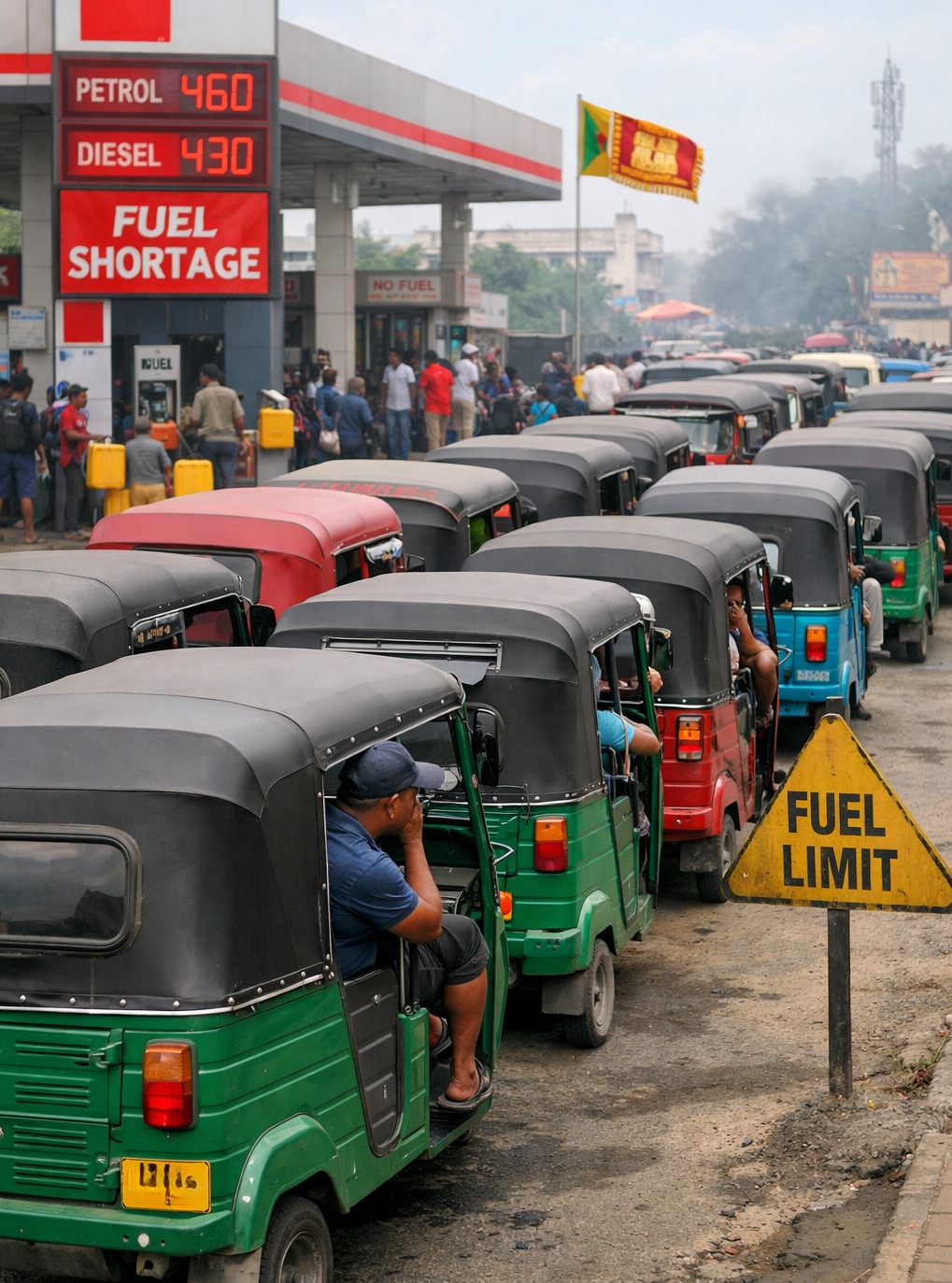
Sri Lanka, located in the Indian Ocean and sharing the same vital sea lanes with the Middle East, is facing significant impacts from the ongoing US-Israel military campaign against Iran, which began on February 28, 2026. Petrol and diesel prices have risen sharply by about 25–33% in recent weeks, with regular petrol reaching around LKR 398 per litre. The government has reintroduced fuel rationing through the National Fuel Pass system and ordered a 25% cut in energy consumption. This includes switching off street lights, neon signs, and billboards. A four-day work week with Wednesdays off for non-essential government, public sector, schools, and universities has been implemented to conserve fuel.
Significantly, India has delivered 38,000 metric tonnes of fuel to Sri Lanka after supply disruptions linked to the West Asia conflict, stepping in as Colombo faces shortages, invokes emergency measures, and seeks stability through closer energy cooperation with New Delhi. This support came days after a phone conversation between Prime Minister Narendra Modi and President Anura Kumara Dissanayake.
Long queues at fuel stations have become common, while higher transport costs are disrupting daily life, deliveries, and businesses. These developments raise risks of higher inflation, pressure on the balance of trade, and depreciation of the rupee. Remittances from Sri Lankan workers in the Middle East a major source of foreign exchange and the tourism sector, hit by higher jet fuel prices and flight disruptions, also face strain. Shipping and freight costs have risen further due to rerouted vessels and increased insurance premiums.
Public frustration is evident, with many queuing for limited fuel quotas, cutting back on meals, and questioning why their country must suffer from conflicts between major powers. Opposition parties have called for protests against what they describe as the “US-Israeli imperialist war on Iran.” Some exemptions from fuel restrictions have been granted to tourism operators to protect this key economic sector.
Compounding Domestic Challenges
Sri Lanka’s difficulties have been aggravated by recent events. The country is still recovering from Cyclone Ditwah in late 2025, one of the worst natural disasters in its post-independence history. The cyclone caused widespread devastation to livelihoods, infrastructure, agriculture, and public finances, with reconstruction costs estimated at around USD 4.1 billion. Many people remain displaced or in temporary shelters months later.
Adding to these woes, the tea industry a vital export earner faces weekly losses of USD 10–15 million due to the Middle East conflict. Major shipping lines suspended services in the initial stages, and several regional seaports were temporarily closed. Although limited operations resumed from early March, freight charges have increased significantly, and there is a lack of regular scheduled vessels from Colombo to Middle Eastern destinations.
Economic Recovery in Peril
Sri Lanka’s latest fuel price hikes, announced by the Ceylon Petroleum Corporation and matched by Lanka IOC, have triggered renewed anxiety in an already fragile economy. The sharp revisions come amid global oil markets under severe stress, with Brent crude surpassing $100 per barrel due to disruptions in the Strait of Hormuz.
The island’s fragile post-2022 economic recovery now faces a “brutal reality check.” Fuel costs lie at the core of transport, logistics, agriculture, fisheries, fertilizers and manufacturing. Even modest diesel price increases historically cause rapid spikes in food and retail prices, and a similar pass-through effect appears inevitable. Higher fuel import bills are expected to strain households whose incomes have not fully recovered from previous shocks.
The Colombo Stock Exchange took a sharp hit, with the All-Share Price Index (ASPI) plunging more than 3% in a single session to around 20,950 points, one of the steepest one-day drops in months. Optimism about post-2022 stabilisation is now colliding with global instability and soaring energy prices. As Sri Lanka approaches the combined fifth and sixth reviews of its IMF programme the assessment will examine not only fiscal reforms but also the broader economic impact of the Middle East conflict.
Geopolitical Spillover
The conflict has spilled directly into Sri Lankan waters. On March 4, 2026, a US Navy submarine torpedoed the Iranian frigate IRIS Dena approximately 19–40 nautical miles off Galle. Sri Lanka’s Navy and Air Force conducted search-and-rescue operations, saving 32 survivors and recovering dozens of bodies (reports cite around 87 fatalities). A second Iranian vessel, the IRIS Bushehr, sought safety nearby, with its crew taken into humanitarian custody.
In explaining the government’s decision to deny access to US fighter aircraft and Iranian naval vessels, President Anura Kumara Dissanayake has firmly reiterated Sri Lanka’s policy of strict neutrality and non-alignment. By refusing these requests, Colombo seeks to avoid entanglement in external power struggles, even as the domestic economy faces intense pressure.
Amid this backdrop, the US Ambassador to India and Special Envoy for South and Central Asia Sergio Gor visited Sri Lanka and the Maldives from March 19 to 24, 2026. At Colombo, he met President Dissanayake at the Presidential Secretariat to discuss bilateral ties, trade, and commercial cooperation. Gor also joined Sri Lanka Navy Chief of Staff Rear Admiral Damian Fernando aboard SLNS Gajabahu (a former US Coast Guard cutter) and highlighted ongoing naval cooperation, including the impending arrival of another ex-US cutter.
US statements emphasised safeguarding vital sea lanes, secure ports, and advancing a “free, open, and prosperous Indo-Pacific.” The visit is widely viewed as Washington’s effort to reinforce influence in the Indian Ocean at a time when Colombo is negotiating emergency fuel supplies with India, China, and Russia. President Dissanayake used the occasion and a subsequent parliamentary statement to publicly stress strict impartiality, helping to quell domestic criticism from the opposition wary of a pro-US tilt.
Trincomalee as Long-Term Resilience
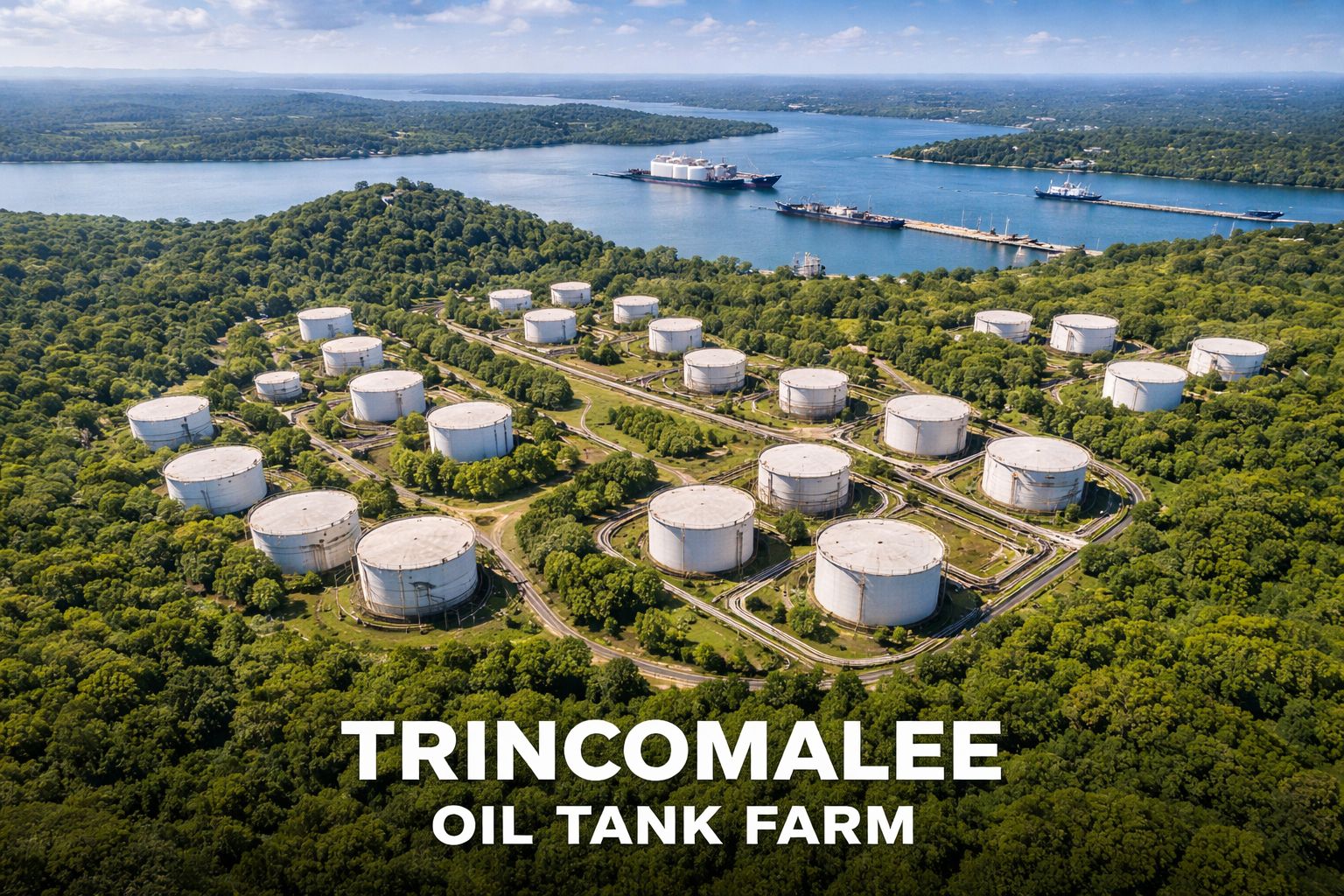
While the Iran crisis has thrust Sri Lanka into an acute fuel crisis marked by rationing, conservation measures, and short-term stocks the situation has spotlighted a viable long-term pathway out of vulnerability. As Foreign Minister Vijitha Herath declared in Parliament, the redevelopment of the historic Trincomalee oil tank farms represents the “permanent solution” and “the only credible long-term answer” to the island’s energy insecurity amid volatile global conditions.
The April 2025 Memorandum of Agreement with India and the UAE signed during Prime Minister Narendra Modi’s visit to Colombo provides the framework to transform Trincomalee into a modern regional energy hub. This includes modernising the World War II-era tank farms, establishing refining and distribution infrastructure, and advancing a joint venture between the Ceylon Petroleum Corporation and Indian Oil Corporation. By expediting technical reviews and launching a transparent tender for investors, Sri Lanka can move beyond short-term austerity toward genuine energy resilience and strategic storage capacity.
Japan can serve as a pivotal partner by offering concessional financing and advanced technological expertise for the modernisation of Trincomalee’s infrastructure. Through its Japan International Cooperation Agency (JICA), Japan has a long history of supporting large-scale energy, power transmission, and port-related projects in Sri Lanka with high-quality engineering and sustainable practices. Building on the 2023 India-Sri Lanka-Japan trilateral discussions that explored developing Trincomalee as a regional energy/storage hub with potential for oil, LNG, and green hydrogen, Japanese participation would bring additional capital, cutting-edge technology for tank farm rehabilitation and refining facilities, and a strong emphasis on environmental compliance thereby accelerating the project while enhancing its overall quality and bankability.
This development aligns seamlessly with India’s Neighbourhood First Policy, which emphasises collaborative growth with its immediate neighbours, and its broader MAHASAGAR vision of mutual security and holistic advancement across regions. For both nations, this presents a timely mutual opportunity. Sri Lanka gains diversified oil storage and distribution capabilities that reduce its dependence on distant and often disrupted supply routes, while India strengthens its ties with a strategically located partner in the Indian Ocean, thereby enhancing regional energy connectivity and integration. In the shadow of the Iran conflict and recurring supply shocks, accelerating the Trincomalee project could mark a pragmatic step toward Sri Lanka’s energy sovereignty and deeper Indo-Sri Lankan economic partnership turning a moment of hardship into a foundation for long-term stability.
Lessons from the Past
A useful lesson can be drawn from the final months of the previous government that presided over Sri Lanka’s 2022 economic collapse. Authorities repeatedly delayed fuel price adjustments despite rising global oil costs and foreign exchange shortages. This placed enormous pressure on the import system, leading to acute shortages and long queues that became symbols of the crisis and fuelled public anger. The current administration would do well to remember that while delaying adjustments may offer short-term political relief, failure to act decisively amid sustained high global prices and strained supplies could recreate conditions that triggered the last political upheaval.
Importantly, the swift and practical support extended by India including the recent delivery of 38,000 metric tonnes of fuel serves as a timely buffer that helps mitigate public discontent. Despite fuel demands domestically, India prioritised assistance to Sri Lanka, stepping in as a reliable partner during the crisis triggered by West Asia disruptions. By providing this emergency supply through Lanka IOC following the phone conversation between Prime Minister Narendra Modi and President Anura Kumara Dissanayake. India’s gesture not only provides immediate energy stability but also helps prevent Colombo’s domestic economic frustrations from turning into any potential anti-India sentiments. This collaborative approach reinforces mutual trust and demonstrates the value of closer cooperation. In a volatile regional environment, such pragmatic partnerships can help Sri Lanka maintain domestic stability.
Sri Lanka’s ability to navigate this domestic crisis and external oil shock will depend on pragmatic diplomacy, energy diversification, and timely structural measures. The coming weeks and months will test the resilience of both its economy and its policy of strategic neutrality.
References
- The Hindu. (2026, March 29). India sends 38,000 metric tonnes of fuel to support Sri Lanka.
https://www.thehindu.com/news/national/india-sends-38000-metric-tonnes-of-fuel-to-support-sri-lanka/article70795702.ece - Daily Mirror. (2026, March 27). India steps in with emergency fuel shipment.
https://www.dailymirror.lk/breaking-news/India-steps-in-with-emergency-fuel-shipment/108-336530 - lk. (2026, March 27). India sends 38,000 MT fuel to Sri Lanka after Modi–AKD talks.
https://www.newswire.lk/2026/03/27/india-sends-38000-mt-fuel-to-sri-lanka-after-modi-akd-talks/ - Ada Derana. (2026, March 9). Fuel price hike in Sri Lanka likely as global oil prices surge.
http://www.adaderana.lk/news/119502/fuel-price-hike-in-sri-lanka-likely-as-global-oil-prices-surge-economist - Al Jazeera. (2026, March 27). Sri Lanka braces for new economic crisis as war on Iran continues.
https://www.aljazeera.com/features/2026/3/27/sri-lanka-braces-for-new-economic-crisis-as-war-on-iran-continues - Associated Press. (2026, March 4). Sri Lanka recovers 87 bodies from Iranian warship sunk off its coast.
https://apnews.com/article/sri-lanka-iran-middle-east-ship-sinking-69191dde43154c5176a8aeacc9128748 - (2026, March 13). Bodies of 84 Iranian sailors killed in US attack to be repatriated.
https://www.bbc.com/news/articles/c363lk4xk07o - (2026, March). Everyday life in Asia is being upended by Iran war fuel crisis.
https://www.bbc.com/news/articles/c1450zj6n48o - Deccan Herald. (2026, March 12). Sri Lanka's tea industry facing a loss of $10 million per week from Gulf region conflict.
https://www.deccanherald.com/asia/sri-lankas-tea-industry-facing-a-loss-of-10-million-per-week-from-gulf-region-conflict-3929068 - Daily FT. (2026, March 23). Vijitha Herath says Sri Lanka to fast-track Trincomalee oil tank farm redevelopment.
https://www.ft.lk/news/Vijitha-Herath-says-Sri-Lanka-to-fast-track-Trincomalee-oil-tank-farm-redevelopment/56-789929 - (2025, April 5). India, UAE to develop Sri Lanka energy hub as Delhi competes with China for influence.
https://www.reuters.com/world/asia-pacific/india-uae-develop-sri-lanka-energy-hub-delhi-competes-with-china-influence-2025-04-05/ - WAM (2025, April 6). UAE, India, Sri Lanka sign tripartite MoU to develop Trincomalee as regional energy hub.
https://www.wam.ae/en/article/bj1itz6-uae-india-sri-lanka-sign-tripartite-mou-develop - Ministry of External Affairs, Government of India. (2025, April 5). Transcript of special briefing by MEA on Prime Minister’s visit to Sri Lanka.
https://www.mea.gov.in/media-briefings.htm?dtl/39378/Transcript+of+Special+briefing+by+MEA+on+Prime+Ministers+visit+to+Sri+Lanka+April+05+2025 - Daily FT. (2026, March 23). Vijitha Herath says Sri Lanka to fast-track Trincomalee oil tank farm redevelopment.
https://www.ft.lk/news/Vijitha-Herath-says-Sri-Lanka-to-fast-track-Trincomalee-oil-tank-farm-redevelopment/56-789929 - (2025, December 22). Sri Lanka Cyclone Ditwah damage estimated at US$4.1bn.
https://economynext.com/sri-lanka-cyclone-ditwah-damage-estimated-at-us4-1bn-254421/ - France 24. (2026, March 22). Sri Lanka raises fuel prices by 25 percent as war bites.
https://www.france24.com/en/live-news/20260322-sri-lanka-raises-fuel-prices-by-25-percent-as-war-bites - International Monetary Fund. (2026, March 19). IMF statement on Sri Lanka.
https://www.imf.org/en/news/articles/2026/03/19/pr26082-sri-lanka-imf-statement - (2026, March 2). Sri Lankan drivers queue to fill up in wake of Iran turmoil.
https://www.reuters.com/business/energy/sri-lankan-drivers-queue-fill-up-wake-iran-turmoil-2026-03-02/ - The Guardian. (2026, March 16). Sri Lanka brings in four-day week to eke out stocks of oil and gas hit by Iran war.
https://www.theguardian.com/world/2026/mar/16/sri-lanka-four-day-week-oil-and-gas-iran-war - The Hindu. (2026, March 21). Sri Lanka looks to India-backed Trincomalee project amid energy crisis.
https://www.thehindu.com/news/international/sri-lanka-looks-to-india-backed-trincomalee-project-amid-energy-crisis/article70769118.ece - The Hindu. (2026, March 22). Sri Lanka raises fuel prices by 25% as war bites.
https://www.thehindu.com/news/international/iran-israel-war-sri-lanka-fuel-price-increase-march-22-2026/article70771619.ece - The Island. (2026, March). SL to redevelop Trinco tank farm expeditiously.
http://island.lk/sl-to-redevelop-trinco-tank-farm-expeditiously/ - The Straits Times. (2026, March). Sri Lanka raises fuel prices by 25% as Iran war bites.
https://www.straitstimes.com/asia/south-asia/sri-lanka-raises-fuel-prices-by-25-as-war-bites - Times of India. (2026, March 17). Iran war impact: Sri Lanka shifts to 4-day week to conserve fuel.
https://timesofindia.indiatimes.com/world/south-asia/iran-war-impact-sri-lanka-shifts-to-4-day-week-to-conserve-fuel/articleshow/129624426.cms - S. Department of State. (2026, March 18). U.S. Special Envoy Gor’s travel to Sri Lanka and Maldives.
https://www.state.gov/releases/office-of-the-spokesperson/2026/03/u-s-special-envoy-gors-travel-to-sri-lanka-and-maldives - United Nations. (2026, March 19). Middle East war shockwaves ripple through Asia-Pacific fuel supplies.
https://news.un.org/en/story/2026/03/1167167 - Washington Post. (2026, March 5). Iranian warship sunk by the US was sailing home after taking part in an exhibition hosted by India.
https://www.washingtonpost.com/world/2026/03/05/iran-warship-iris-dena-india/4b0e7c3a-1885-11f1-aef0-0aac8e8e94db_story.html - World Bank. (2025, December 22). Damage from Cyclone Ditwah in Sri Lanka estimated at $4.1 billion
https://www.worldbank.org/en/news/press-release/2025/12/22/damage-from-cyclone-ditwah-in-sri-lanka-estimated-at-4-1-billion - (2026, March 28). Sri Lankan government institutes huge fuel price increases.
https://www.wsws.org/en/articles/2026/03/28/hzkz-m28.html - Pathfinder Foundation. (2023). India-Sri Lanka-Japan trilateral cooperation: Low-carbon power generation and development of Trincomalee as an energy hub.
https://www.jetro.go.jp/view_interface.php?blockId=36267909
DisclaimerMr. Balasubramanian Chandrashekar is a Senior Advisor at the Deccan Centre for International Relations. The views expressed are those of the author and do not reflect the views of the Deccan Centre for International Relations.