
Advancing South India’s Global Agenda

Issue Brief No (06): Geopolitics of Semiconductor Supply Chains: Global Fragmentation and South India’s Technological Ambitions: D.Divyalakshmi
BackIssue Brief No (06): Geopolitics of Semiconductor Supply Chains: Global Fragmentation and South India’s Technological Ambitions: D.Divyalakshmi
Issue Brief No: 06
Geopolitics of Semiconductor Supply Chains: Global Fragmentation and South India’s Technological Ambitions
Author: D.Divyalakshmi
(Department of International Studies, Women’s Christian College)
Abstract
This paper analyses the vulnerabilities of South India’s emerging semiconductor ecosystem amidst growing geopolitical instability in West Asia and the Taiwan Strait. Even though South Indian states such as Tamil Nadu, Karnataka and Telangana have become important centres for electronics manufacturing and chip design, it is mainly enabled via external suppliers for advanced fabrication technologies, semiconductor equipment and critical industrial inputs. The study argues that disruptions in West Asian energy corridors and tensions surrounding Taiwan increase operational costs through shipping disruptions, energy-price volatility and supply chain delays, which portray structural weaknesses in South India’s industrial development model. On the other hand, these pressures have been encouraging efforts toward supply chain diversification, domestic manufacturing and strategic specialization in mature-node and compound semiconductors. The paper concludes that while South India is gradually strengthening its semiconductor capabilities, long-term resilience is constrained by infrastructural limitations, import dependence and workforce shortage in fabrication associated skills.
Keywords: Semiconductor Supply Chains, South India, Geopolitics, Semiconductor Resilience, Taiwan Strait
Introduction
South India has been instrumental in widening the scope of India’s semiconductor ambitions through policy incentives, FDIs and industrial growth concentrated in Tamil Nadu, Karnataka, Telangana and Andhra Pradesh. Namely, Bengaluru’s development in semiconductor designing and Chennai-Sriperumbudur corridor’s centrality in electronics and automotive manufacturing have paved way for a slow and steady capacity building in Assembly, Testing, Marking and Packaging (ATMP/OSAT) operations within the India Semiconductor Mission (ISM).
This growth is nurtured by the geopolitically sensitive West and East Asian supply chains. Semiconductor manufacturing is propelled by West Asian countries providing industrial raw materials like helium, bromine, petrochemical derivatives, LNG and energy resources. In East Asia, semiconductor fabrication is mainly dominated by Taiwanese firms, which support India via advanced chips and technical partnerships (Carnegie Endowment for International Peace, 2024; ORF, 2024).
Recent conflicts around both of these regions have exposed the fragility of India’s structural dependence. The US-Iran clash and Red Sea disruptions have surged shipping costs, delayed industrial inputs and have resulted in cascading aftereffects due to unreliable energy supply and pricing, while tensions in the Taiwan Strait have led to uncertainty in the continued access to advanced semiconductor technology. These interruptions create compounding risks for South India’s semiconductor ecosystem because it is a highly energy-intensive process backed by tightly knit logistics networks.
This paper sketches how South India’s semiconductor trajectory is susceptible to geopolitical repercussions in West Asia and the Taiwan Strait, which in turn are pushing self-reliance efforts spanning ATMP expansion, mature-node manufacturing and selective semiconductor resilience initiatives across South India.
1. Research Questions and Analytical Approach
The paper adopts a qualitative policy-analysis approach using secondary data, industry reports, and geopolitical assessments. It also attempts to analyse the following questions.
- How do geopolitical disruptions in West Asia and the Taiwan Strait affect South India’s semiconductor ecosystem?
- To what extent can South India reduce external technological dependence through strategic repositioning?
- What structural constraints limit South India’s semiconductor resilience?
2. South India’s Semiconductor Ecosystem and Strategic Positioning
South Indian states together have emerged as the spine of India’s Electronics System Design and Manufacturing (ESDM) network, which collaborates versatile strengths in electronics manufacturing, chip design, automobile production and developing semiconductor infrastructure, which boost the country’s technological ambitions under the India Semiconductor Mission (ISM).
Table 1 : South India’s Semiconductor Ecosystem
|
STATE |
CORE STRENGTHS |
MAJOR FIRMS / ECOSYSTEMS |
POLICY PUSH |
|
Tamil Nadu Chennai–Sriperumbudur electronics and automotive corridor |
Electronics manufacturing, automotive electronics, export-oriented assembly |
Foxconn, Pegatron, Hyundai, Renault-Nissan, Dell |
Semiconductor & Advanced Electronics Policy 2024; up to 50% capital subsidy; semiconductor parks in Sulur and Palladam (Government of Tamil Nadu, 2024) |
|
Karnataka |
Semiconductor design, R&D, fabless ecosystem |
Intel, AMD, Qualcomm, Texas Instruments, Lam Research |
ESDM incentives; Bengaluru as India’s semiconductor design hub, contributing to nearly 20% of the global design workforce (ISM, 2024) |
|
Telangana |
GCC ecosystem, AI infrastructure, semiconductor design |
Hyderabad GCC ecosystem, electronics and AI investments |
Telangana Electronics Policy and semiconductor investment promotion (NASSCOM, 2025; Telangana Electronics Policy, 2023) |
|
Andhra Pradesh |
ATMP/OSAT and downstream packaging |
ASIP Technologies and packaging-focused ventures |
Competitive semiconductor subsidies reportedly up to 60% for select investments (Government of Andhra Pradesh, 2024) |
Note. ATMP = Assembly, Testing, Marking and Packaging; OSAT = Outsourced Semiconductor Assembly and Testing; ESDM = Electronics System Design and Manufacturing; GCC = Global Capability Centre.
Source: Compiled by the author using data from the Government of Tamil Nadu (2024), India Semiconductor Mission (2024), Telangana Electronics Policy (2023), NASSCOM (2025), Government of Andhra Pradesh (2024), Invest India (2025), and India Electronics and Semiconductor Association (2025).
Although South India’s collective transition from an assembly plus design ecosystem to an efficient semiconductor manufacturing network is advantageous, the region still pertains to be structurally held on by external supply chains for advanced fabrication, semiconductor manufacturing equipment (SME), special chemicals and high end chips (Observer Research Foundation [ORF], 2024; India Electronics and Semiconductor Association [IESA], 2025). A paradox of strategic centrality and technological dependence is established, where South India’s indispensable contribution to India’s industrial expansion is directly proportional to imports from geographically concentrated global semiconductor nodes.
3. Global Semiconductor Fragmentation and Strategic Chokepoints
The global semiconductor industry revolves around a highly disjointed and bottlenecked supply chain where the subsequent stages of production are handled by a few countries with specialised capabilities. Taiwan dominates advanced chip fabrication, the Netherlands controls extreme ultraviolet (EUV) lithography through ASML, while West Asia supplies essential industrial inputs such as helium, bromine, LNG and petrochemical derivatives required for semiconductor manufacturing (CSIS, 2024; ORF, 2024). This concentration transforms semiconductors from a commercial product into a strategic geopolitical asset.
For South India, which depends heavily on imported chips, manufacturing equipment, speciality gases and advanced fabrication technologies, disruptions in any of these chokepoints translate directly into industrial vulnerability. As Vijay Gokhale argues, instability in the Taiwan Strait would carry far-reaching consequences for regional economic stability and global supply chains (Gokhale, 2023). The following table outlines the major geopolitical dependencies shaping South India’s semiconductor ecosystem.
Table 2 : Geopolitical Semiconductor Chokepoints and Strategic Risks for South India
|
CHOKEPOINT |
STRATEGIC DEPENDENCY |
NATURE OF DISRUPTION |
SOUTH INDIA’S EXPOSURE |
STRATEGIC RISK |
|
West Asia & Red Sea Corridor |
Helium (30–33% linked to Qatar), bromine, LNG, petrochemicals, maritime shipping routes |
Iran conflict, Red Sea rerouting, energy volatility |
10–15 day shipping delays, 20–30% rise in OSAT and logistics costs, PCB manufacturing pressure (Reuters, 2026; UNCTAD, 2026) |
Higher operating costs across the Chennai–Sriperumbudur electronics corridor |
|
Taiwan Strait |
Advanced chip fabrication, foundry services, semiconductor IP partnerships |
Rising military tensions, blockade risk and investment uncertainty |
Vulnerability in automotive electronics, consumer electronics, fabless chip design ecosystem |
Risks to Tata–PSMC partnerships and future fabrication expansion |
|
Netherlands, US, Japan Technology Axis |
EUV lithography (ASML), SME tooling, photoresists and advanced semiconductor chemicals |
Export controls and technology restrictions linked to the US–China rivalry |
Restricted access to advanced fabrication technology and high end manufacturing equipment |
Limits India’s transition toward advanced-node fabrication |
|
East Asian Semiconductor Concentration |
South Korean memory chips, Taiwanese foundries and Japanese materials |
Supply concentration across a few geographies |
Delayed chip imports affecting EVs, telecom, data centres, and AI infrastructure |
Reinforces dependence on external semiconductor ecosystems |
Note. OSAT = Outsourced Semiconductor Assembly and Testing; SME = Semiconductor Manufacturing Equipment.
Source: Compiled by the author using data from Reuters (2026), UNCTAD (2026), CSIS (2024), ORF (2024), Carnegie Endowment for International Peace (2024), India Semiconductor Mission (2024), Global Taiwan Institute (2024), and McKinsey Global Institute (2024).
4. Semiconductor Disruptions and Sectoral Risks in South India
Geopolitical disruptions across West Asia and the Taiwan Strait increasingly affect South India’s industrial ecosystem because the region’s automobile, electronics, digital infrastructure, and semiconductor design sectors remain deeply integrated with external supply chains. As semiconductor imports, logistics routes, and industrial inputs become vulnerable to geopolitical instability, production costs, manufacturing timelines, and investment certainty across South India’s major industrial corridors are also affected.
Figure 1 : Sectoral Exposure of South India’s Semiconductor Ecosystem to Global Supply Chain Disruptions
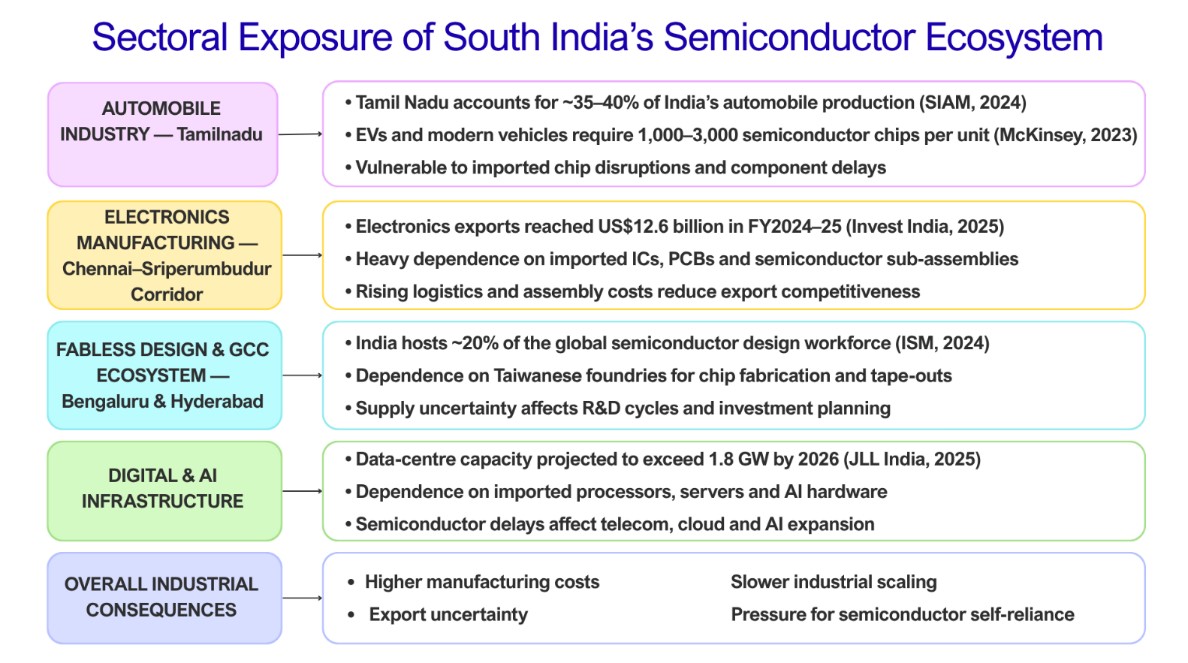
Note. GCC = Global Capability Centre; ICs = Integrated Circuits; PCBs = Printed Circuit Boards.
Source:Compiled by the author using data from Society of Indian Automobile Manufacturers (2024), McKinsey & Company (2023), Invest India (2025), India Semiconductor Mission (2024), JLL India (2025), India Electronics and Semiconductor Association (2025), and Deloitte India (2024).
5. Strategic Repositioning: South India’s Search for Semiconductor Resilience
The friction around West Asia and Taiwan Strait has been the driving force behind the initiatives undertaken by governments and firms for supply chain diversification beyond these regions. As specific areas of South India already possess an upper hand in industrial infrastructure and technological know-how, this source alteration would allow it to upgrade from mere chip designing and electronics assembly to building manufacturing depth, packaging capacity and supply chain resilience which would help in navigating geopolitical shocks. The India Semiconductor Mission (ISM) fastracks this evolution, as the Indian government has allocated nearly $10 billion in incentives to semiconductor and display manufacturing (India Semiconductor Mission, 2025). 12 semiconductor projects, including fabrication and ATMP/OSAT facilities, have been approved by India in 2026, and many of these are expected to become operational by the end of the year (MeitY, 2026).
India’s strategic focus on mature-node semiconductors (28-90 nm) and downstream semiconductor operations of Assembly, Testing, Marking and Packaging (ATMP/OSAT) requires a considerably low capital investment (ORF, 2024) compared to making advanced sub-7 nm fabricated chips like TSMC, and it's also achievable with India’s current industrial capabilities. Tamilnadu, Karnataka and Telangana are exploiting these opportunities through firms like Kaynes Semicon to carry out investments in ATMP operations associated with automotive electronics, industrial systems and embedded technologies (Kaynes Technology India, 2025). South India’s current trajectory reflects a phased industrial model in which strong fabless design ecosystems and ATMP/OSAT operations are expected to serve as a foundation for future fabrication capabilities. India has also been luring in FDIs and partnerships with the multinational firms of Taiwan, Japan and the USA by way of state-level subsidies, land incentives, tax exemptions and infrastructure support to expand the microelectronics industry.
Policy makers and industrialists of the region have recognised the level of impact to be beyond manufacturing hurdles with regard to chip imports, as disturbances in the inflow of special gases, petrochemical byproducts, semiconductor chemicals and fabrication technology also present drawbacks. Therefore, there has been a new stress on upstream integration within the ISM framework to diversify sources of rare materials like helium and bromine, bolster domestic semiconductor chemical production and encourage localised equipment servicing as a corroboration of the “Make in India” scheme.
Subsequently, South India has been aligning its policy with the emerging compound semiconductors such as Gallium Nitride (GaN) and Silicon Carbide (SiC) necessary for EVs, renewable energy systems, industrial electronics and defence tech (International Energy Agency [IEA], 2025). There’s also a bubbling emphasis on indigenous intellectual property and design-led manufacturing utilizing India’s skilled human resources to procure greater technological sovereignty and proprietary semiconductor solutions for critical infrastructure sectors. South India’s response to semiconductor vulnerability now extends beyond managing supply disruptions. Through manufacturing expansion, strategic partnerships and supply chain diversification, the region is gradually repositioning itself within a changing global technology order. Although dependence on external technology remains significant, geopolitical instability has accelerated efforts to build a more resilient semiconductor ecosystem.
6. Structural Constraints and Limits of Semiconductor Resilience
Despite attempts for strategic repositioning and initiatives that advance indigenous capacity, South India’s semiconductor ambitions face significant structural shortcomings that hinder the momentum of industrial transformation. The region’s persistent dependence on imported Semiconductor Manufacturing Equipment (SME), speciality chemicals and high-purity materials poses a major challenge. Only a handful of firms in the Netherlands, Japan and the USA own advanced lithography systems, semiconductor manufacturing equipment (SME), photoresists and memory technologies needed for cutting-edge fabrication.
Infrastructural disadvantage persists as semiconductor fabrication requires an uninterrupted electric power supply and large volumes of ultra-pure water under highly controlled conditions. A single advanced fabrication plant can consume millions of gallons of water daily (Semiconductor Industry Association, 2024), which raises sustainability concerns in parts of Tamil Nadu and Karnataka with water shortages. Simultaneously, maintaining a stable power supply for fabrication remains difficult since semiconductor fabrication is highly energy intensive, rendering its operating costs sensitive to LNG shortages, oil-price volatility and electricity disruptions linked to West Asian instability.
Another major limitation is that, there is a significant mismatch between India’s design-oriented talent pool and the requirements of large-scale fabrication manufacturing. South India possesses one of the world’s largest demography of semiconductor design engineers nevertheless the ecosystem continues to face shortages in cleanroom technicians, process engineers and semiconductor materials specialists. Industry estimates suggest that India could face a shortfall of over 300,000 skilled workers (TeamLease Digital, 2025) across the semiconductor value chain as manufacturing capacity expands.
Financial and regulatory restrictions further complicate this transition. Semiconductor fabrication facilities often require investments exceeding $10 billion (McKinsey Global Institute, 2024), while lengthy gestation periods and relatively high borrowing costs in India undermine investor confidence compared to competing Asian manufacturing hubs. Impediments related to land acquisition, environmental clearances and infrastructure development also pose obstacles in an industry where technological cycles evolve rapidly.
These compounding risks indicate that while South India’s semiconductor ecosystem is expanding, the transition toward manufacturing resilience will likely remain gradual and uneven, dependent not only on geopolitical opportunity but also on sustained institutional and industrial capacity-building.
7. Key Findings and Inferences
a) South India’s semiconductor rise is marked by a paradox of strategic centrality and technological dependence.
South India is responsible for nearly 37% of India’s electronics exports and hosts a major share of the country’s semiconductor design ecosystem, yet advanced fabrication, semiconductor manufacturing equipment (SME), and critical materials remain heavily import-dependent (Invest India, 2025; ISM, 2024). It could be inferred that South India possesses strong design and manufacturing integration ability but lacks material and technological sovereignty.
b) Geopolitical disruptions now function as industrial risks rather than distant strategic events.
The Iran conflict, Red Sea rerouting, and Taiwan Strait tensions have demonstrated how external geopolitical shocks directly affect semiconductor manufacturing through shipping delays, rising energy costs, helium shortages, and chip supply uncertainty. Rather than causing immediate industrial collapse, these disruptions impose a cumulative “geopolitical time tax” through a 20% to 30% increase in operational costs and extend component lead times to nearly 12 weeks (Reuters, 2026; UNCTAD, 2026).
c) South India is repositioning itself through selective semiconductor specialization.
Instead of competing immediately in advanced-node fabrication, India’s semiconductor strategy increasingly focuses on mature-node chips (28-90 nm), ATMP/OSAT operations, automotive electronics and compound semiconductors such as GaN and SiC. This suggests that India’s near-term semiconductor resilience will likely emerge through selective specialization and supply chain diversification rather than technological parity with Taiwan or South Korea.
d) Structural constraints continue to limit semiconductor resilience.
Despite policy support under the India Semiconductor Mission (ISM), the ecosystem remains constrained by high capital intensity, imported SME dependence, infrastructure gaps, water and energy pressures, and a shortage of skilled workers. Consequently, South India’s semiconductor future is characterized by a gradual and uneven shift toward manufacturing, where true resilience is limited by long-term institutional and infrastructural gaps.
e) Semiconductor industrialization has also created a resource-security dilemma.
Advanced semiconductor manufacturing requires large volumes of ultra-pure water and uninterrupted electricity, particularly in water-stressed regions of Tamil Nadu and Karnataka. This creates a greater “guns versus butter” challenge in which national spending on industrial expansion must be balanced against environmental sustainability and local resource security.
8. Recommendation
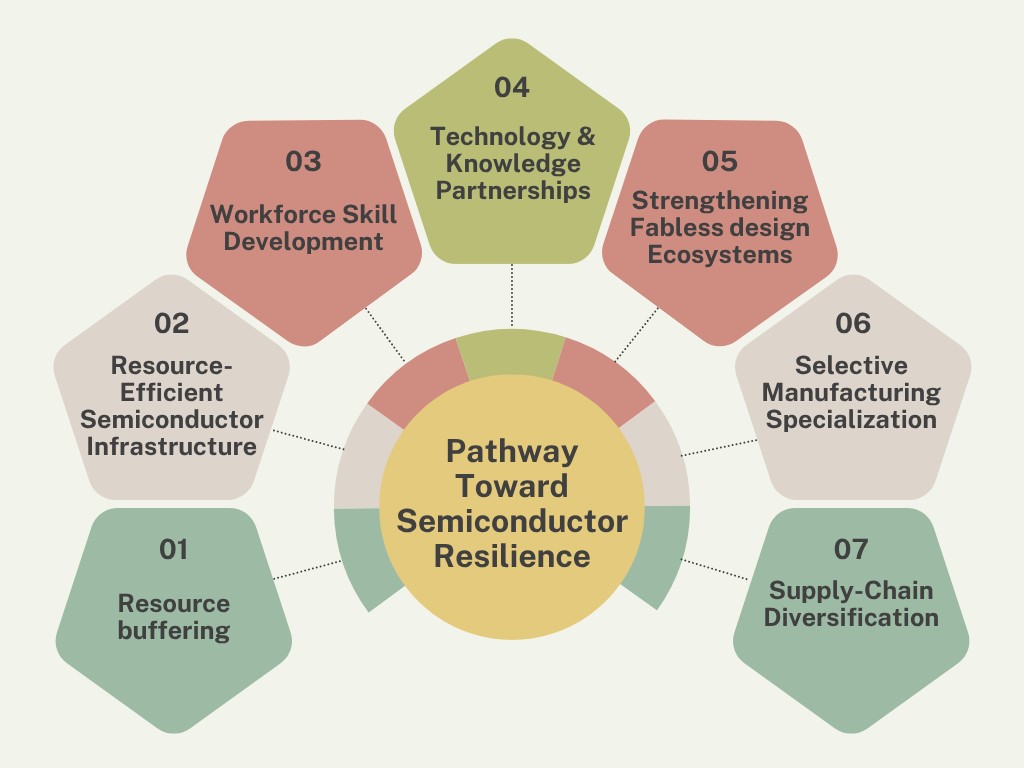
Based on the geopolitical and structural vulnerabilities identified, the paper recommends the following measures:
Figure 2 : Pathway Toward Semiconductor Resilience in South India
Source: Author’s illustration based on ORF (2024), CSIS (2024), India Semiconductor Mission (2025), McKinsey Global Institute (2024), and Deloitte India (2024).
- Establishing national reserves for critical semiconductor inputs such as helium, neon, bromine, and petrochemical derivatives would serve as a resource buffer to reduce West Asian supply uncertainty.
- Developing semiconductor infrastructure like dedicated power corridors, circular water-recycling systems and sustainable industrial utilities for semiconductor parks would be resource-efficient in water-stressed regions of South India.
- Expanding specialized training programmes for cleanroom technicians, process engineers and semiconductor manufacturing personnel would address the projected workforce shortage and enhance skill upgradation.
- Moving beyond financial FDI toward joint R&D centres to garner long-term technology partnerships with Taiwanese, Japanese, South Korean, and American semiconductor firms.
- Extending incentives for fabless semiconductor startups, chip design R&D and university–industry collaboration in Bengaluru, Hyderabad, and Chennai will strengthen India’s long-term transition from design and ATMP operations toward fabrication capabilities.
- Prioritizing mature-node semiconductors, ATMP/OSAT operations and compound semiconductors such as GaN and SiC will hone the selective industrial and market advantages of South India.
Reducing dependence on geographically concentrated, localized semiconductor ecosystems by diversifying sourcing networks for semiconductor materials, tooling, and fabrication partnerships.
9. Conclusion
South India’s semiconductor ambitions reflect both the opportunities and vulnerabilities of India’s technological rise in an increasingly fragmented geopolitical order. The study shows that disruptions in West Asia and the Taiwan Strait directly affect South India’s manufacturing costs, supply chains, and industrial growth.
At the same time, these geopolitical pressures have accelerated investments in ATMP/OSAT facilities, mature-node manufacturing, fabless chip design and strategic partnerships with Taiwanese, Japanese and American firms. Dependence on imported semiconductor equipment, advanced fabrication technology, critical materials and skilled manufacturing labour, however, continues to limit semiconductor self-reliance. South India’s semiconductor future is likely to depend less on immediate technological dominance and more on its ability to emerge as a resilient and strategically specialised node within global semiconductor supply chains.
REFERENCES:
[1] Asian Development Bank. (2025). Asian economic integration report 2025: Regional supply chain resilience in Asia. Asian Development Bank. https://www.adb.org (n.d.). The substantial benefits of silicon carbide (SiC) and gallium nitride (GaN) inpower electronics. Avnet APAC Resources. https://my.avnet.com/apac/resources/article/the-substantial-benefits-of-silicon-carbide-sic-and-gallium-nitride-gan-in-power-electronics/.
[2] Carnegie Endowment for International Peace. (2024). Taiwan-India chips cooperation and the logic of choosing India. Carnegie Endowment for International Peace. https://carnegieendowment.org/research/2024/08/taiwan-india-chips-cooperation-and-the-logic-of-choosing-india.
[3] Center for Strategic and International Studies. (2024). The geopolitics of semiconductors and strategic technology competition. CSIS. https://www.csis.org
[4] Deloitte India. (2024). India semiconductor market and talent outlook 2024. Deloitte. https://www2.deloitte.com. [5] (2026). Global semiconductor supply chain outlook 2026. Deloitte. https://www2.deloitte.com. [6] Efficient Power Conversion. (n.d.). What is gallium nitride (GaN)? EPC GaN Technology. https://epc-co.com/epc/about-epc/gan-faqs/what-is-gan. [7] Gokhale, V. (2023, April 17). What should India do before the next Taiwan Strait crisis?Carnegie India. https://carnegieendowment.org/research/2023/04/what-should-india-do-before-the-next-taiwan-strait-crisis. [8] Government of Tamil Nadu. (2024). Tamil Nadu semiconductor and advanced electronics policy 2024. Government of Tamil Nadu. https://www.tn.gov.in. [9] Global Taiwan Institute. (2024). Beyond the Strait: Taiwan-India semiconductor cooperation. Global Taiwan Institute. https://globaltaiwan.org/2024/11/beyond-the-strait-taiwan-india-semiconductor. [10] India Electronics and Semiconductor Association. (2025). India semiconductor ecosystem report 2025. IESA. https://www.iesaonline.org. [11] India Semiconductor Mission. (2024). Semiconductor ecosystem development in India. India Semiconductor Mission. https://ism.gov.in. [12] India Semiconductor Mission. (2025). India Semiconductor Mission annual progress report 2025. India Semiconductor Mission. https://ism.gov.in. [13] India Brand Equity Foundation. (2025). Electronics system design and manufacturing industry in India. IBEF. https://www.ibef.org. [14] International Energy Agency. (2025). Critical minerals outlook 2025. IEA. https://www.iea.org. [15] Invest India. (2025). Semiconductor opportunity in India: Semicon India mission, new fabs and global partnerships. Invest India. https://www.investindia.gov.in/team-india-blogs/semiconductor-opportunity-india-semicon-india-mission-new-fabs-global-partnerships. [16] JLL India. (2025). India data center market update 2025. JLL Research. https://www.jll.co.in. [17] Kaynes Technology India. (2025). Annual report 2024–25. Kaynes Technology India Ltd. https://www.kaynestechnology.co.in. [18] McKinsey & Company. (2023). The semiconductor decade: A trillion-dollar industry. McKinsey & Company. https://www.mckinsey.com. [19] McKinsey Global Institute. (2024). Geopolitics and the future of global supply chains. McKinsey Global Institute. https://www.mckinsey.com/mgi. [20] Ministry of Electronics and Information Technology. (2025). India’s semiconductor manufacturing ecosystem: Progress under ISM. Government of India. https://www.meity.gov.in. [21] Ministry of Electronics and Information Technology. (2026). Semiconductor ecosystem status report 2026. Government of India. https://www.meity.gov.in. [22] Ministry of New and Renewable Energy. (2024). Annual report 2023–24. Government of India. https://mnre.gov.in. [23] (2025). India’s digital economy and emerging technology ecosystem. NASSCOM. https://nasscom.in. [24] Observer Research Foundation. (2024). The global microchip conflict: The semiconductorfault line through Taiwan. ORF. https://www.orfonline.org/research/the-global-microchip-conflict-the-semiconductor-fault-line-through-taiwan. [25] (2026). Red Sea crisis and energy disruptions impact global semiconductor supply chains. Reuters. https://www.reuters.com. [26] Semiconductor Industry Association. (2024). 2024 state of the U.S. semiconductor industry. Semiconductor Industry Association. https://www.semiconductors.org. [27] Society of Indian Automobile Manufacturers. (2024). Indian automobile industry performance review 2024. SIAM. https://www.siam.in. [28] TeamLease Digital. (2025). India’s semiconductor talent demand report 2025. TeamLease Digital. https://www.teamleasedigital.com. [29] (2026, March 5). Wide-bandgap semiconductors: How SiC and GaN are transforming power electronics. Tessolve Tech Blogs. [30] United Nations Conference on Trade and Development. (2026). Maritime transport and Red Sea disruption update. UNCTAD. https://unctad.org. [31] UN Comtrade. (2024). India-Taiwan integrated circuit trade statistics. United Nations Comtrade Database. https://comtradeplus.un.org. [32] World Bank. (2025). Infrastructure and industrial resilience in emerging economies. World Bank. https://www.worldbank.org.
D. Divyalakshmi is a Research Intern at the Deccan Centre for International Relations and is currently a postgraduate student at Women's Christian College, Chennai.
Disclaimer: The views and opinions expressed in the article are those of the author and do not necessarily reflect the official position of the Deccan Centre for International Relations.