
Advancing South India’s Global Agenda

Book Review by Mehak Gautam
The Durian Flavour: India and ASEAN after a Decade of the Act East Policy by Gurjit Singh
Back
Book Review by Mehak Gautam
The Durian Flavour: India and ASEAN after a Decade of the Act East Policy by Gurjit Singh
Book Review | Mehak Gautam
The Durian Flavour: India and ASEAN after a Decade of the Act East Policy by Gurjit Singh
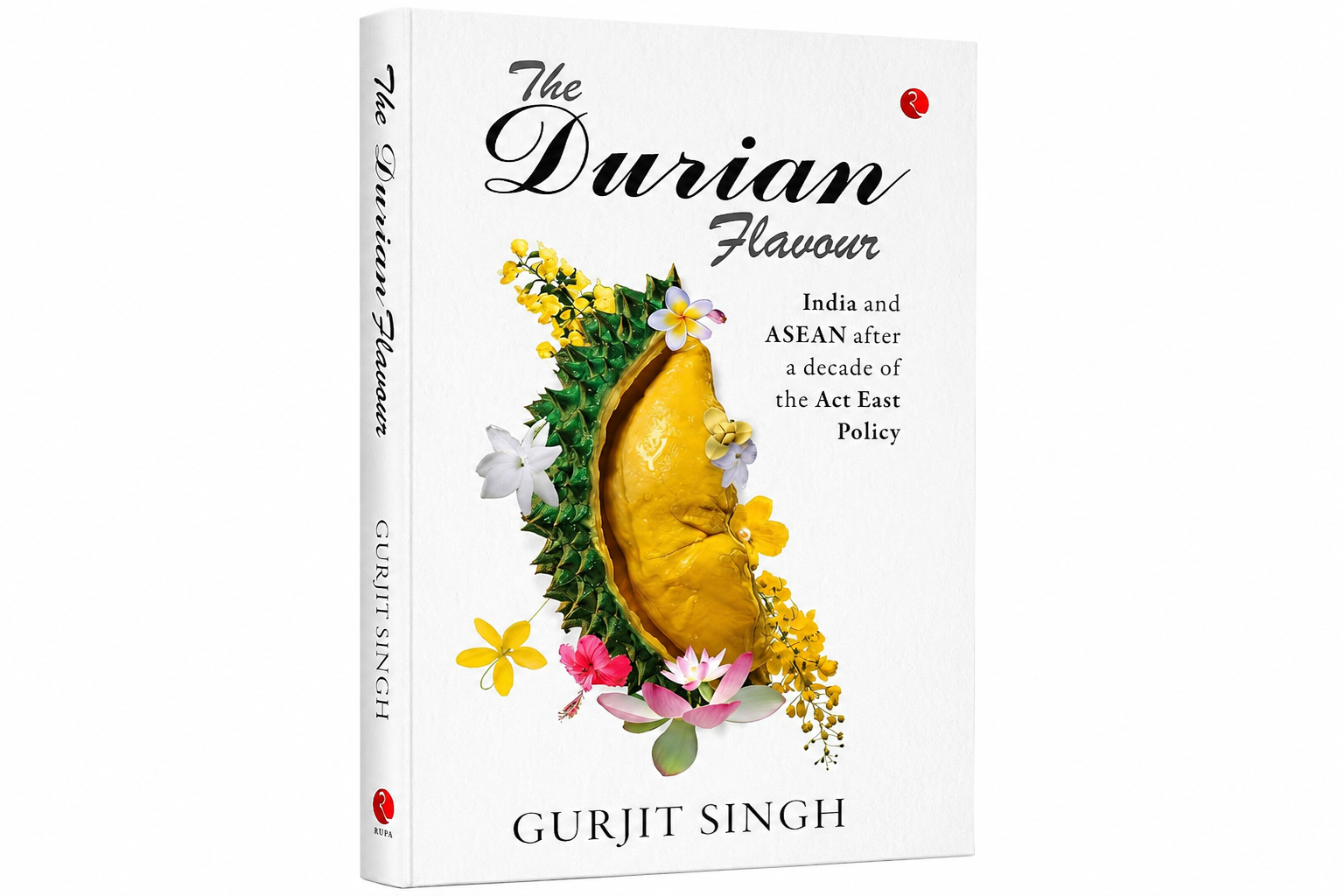
India’s engagement with Southeast Asia has undergone a remarkable transformation over the past three decades, beginning with the economically driven Look East Policy (LEP) launched in the early 1990s by former Prime Minister P.V. Narasimha Rao to the culmination of a much broader strategic vision, the Act East Policy (AEP) by the current Prime Minister Narendra Modi in 2014. New Delhi has steadily expanded its political, economic, and strategic engagement across the Indo-Pacific. Yet, despite the growing significance of ASEAN in India’s foreign policy, few works have actually examined this relationship in a nuanced manner. Gurjit Singh’s latest edition of India-ASEAN—‘The Durian Flavour: India and ASEAN after a Decade of the Act East Policy’, tries to fill this gap with clarity and expert insights.
A former Indian Ambassador to Indonesia, Timor-Leste, Germany, Ethiopia, and the African Union, and India’s representative to ASEAN during a pivotal period in the relationship, Gurjit Singh in his book with his diplomatic experience and policy analysis provides a strategic map to the future of India-ASEAN relations along with the challenges that continue to define them. The Durian Flavours is Gurjit Singh's fourth book in his "culinary metaphor" series (following The Abalone Factor on Japan, Masala Bumbu on Indonesia, and The Injera and the Parantha on Ethiopia), where he uses the durian (a rich delicacy fruit native to Southeast Asia), known for its spiky exterior and divisive reputation, as a symbol of ASEAN’s slow and consensus-bound nature, but whose internal logic and resilience becomes apparent only with familiarity. It is an effective metaphor that captures one of the book’s recurring arguments: ‘successful engagement with ASEAN requires patience, cultural understanding, and long-term commitment rather than expectations of quick diplomatic gains’.
The book’s greatest strength lies in its historical framing as the author argues quite extensively that India and Southeast Asia are related through centuries of shared history and cultural exchanges. He reminds readers of the centuries of maritime trade between India and Southeast Asia, and how the spread of Buddhism and Hinduism influenced the region’s culture, beliefs, and systems of governance, and the vivid cultural exchanges like the author’s account of attending the Ramayana Ballet at Prambanan, wherein the actor playing Arjuna, says “Islam is our religion, but the Ramayana is our culture.” In just a few words, it captures the deep cultural connection that has long existed between India and the South East Asian countries and that continues to exist despite centuries of political and religious change. It was only after the Cold War that these historical linkages were disrupted, creating a gap that India aspires to bridge via its Look East Policy and later the Act East Policy.
The first few chapters focus on the evolution from the Look East Policy to the Act East Policy with considerable detail as he successfully demonstrates that the Look East Policy emerged as a response to India’s post-1991 economic liberalization and the collapse of the Soviet Union and how it was the financial necessity of India initially that drove its engagement with the ASEAN countries. Moreover, this relationship later evolved into a broader strategic partnership encompassing defence cooperation, maritime security, connectivity, technological collaboration, and regional institution-building.
What makes his account different from other scholarly works is his recurrent emphasis on institutions. Instead of focusing only on the summit diplomacy or bilateral relations, Singh devotes special attention to ASEAN’s very own institutional architecture. The evolution from Sectoral Dialogue Partnership to Dialogue Partnership, Summit Partnership, Strategic Partnership, and finally Comprehensive Strategic Partnership is explained not as bureaucratic milestones but as an indicator of a gradually deepening partnership between India and ASEAN.
The author’s very own diplomatic experience supports this argument as in his discussions of negotiations within ASEAN, the drafting of strategic partnership documents, and interactions with diplomats from member states he provides valuable insights into how diplomacy functions beyond official communiqués. His anecdotes help explain the complexities of ASEAN’s institutions and the realities of diplomacy, wherein he repeatedly reminds the readers that diplomacy is often shaped less by grand speeches than by patient negotiation, informal conversations, and gradual consensus-building.
Another notable contribution of the book is its nuanced treatment of China. The book acknowledges China’s growing presence in the South China Sea and its implications for ASEAN’s strategic autonomy; he argues that India’s advantage lies elsewhere. Rather than competing directly with China, India offers ASEAN a partnership rooted in democratic governance, capacity building, education, technology, healthcare, maritime cooperation, and respect for sovereignty. This perspective broadens the understanding of India’s regional role beyond the increasingly dominant narrative of great-power rivalry. Throughout the book he mentions the missed opportunities, bureaucratic delays, incomplete connectivity projects, uneven trade performance, and continuous implementation deficits, which remains one of the greatest challenges in their partnership. By highlighting these shortcomings, he offers a balanced assessment of both the achievements and the potential their partnership carries. The chapters devoted to connectivity and regional integration are among the most relevant for contemporary policymakers. Singh argues that physical infrastructure, digital connectivity, supply-chain resilience, and people-to-people exchanges will determine the future trajectory of India–ASEAN relations more than diplomatic declarations alone. His emphasis on the India–Myanmar–Thailand Trilateral Highway, BIMSTEC, the Mekong-Ganga Cooperation framework, and Northeast India’s role shows that the Act East Policy cannot succeed without integrating India’s own border regions into wider Asian economic networks. Perhaps the book’s most significant analytical contribution lies in its understanding of ASEAN’s strategic culture, as he cautions India to interpret ASEAN through the lenses of Western alliance politics or any traditional balance-of-power theory. ASEAN’s preference for consultation, gradualism, consensus, and institutional centrality often frustrates external powers seeking rapid strategic alignment. Yet these very characteristics explain ASEAN’s resilience despite immense internal diversity.
An area which could have been fleshed out more is the perspectives of private industry, regional businesses, and non-state actors especially since the success of the Act East Policy increasingly depends upon commercial integration rather than diplomatic intent alone. ‘The Durian Flavour’ is carefully researched yet readable, making it suitable not only for scholars and practitioners but also for students seeking an introduction to India’s Southeast Asian diplomacy. The book seeks multiple audiences, as it offers policymakers practical reflections drawn from experience, and provides scholars with valuable institutional history, and gives students an accessible account of one of India’s most significant foreign policy transformations. More importantly, it challenges readers to view India–ASEAN relations not as a reaction to contemporary geopolitical competition but as a partnership rooted in shared histories, complementary interests, and a common commitment to a stable regional order. At a time when the Indo-Pacific has become the defining theatre of global politics, Singh’s work serves as a timely reminder that sustainable partnerships are rarely built through military competition alone. They are equally dependent upon trust, institutions, connectivity, and an appreciation of regional political cultures. In that respect, The Durian Flavour offers more than an account of India’s Act East Policy but provides a thoughtful reflection on the nature of diplomacy itself.
For scholars of international relations, practitioners of diplomacy, and anyone interested in India’s evolving role in the Indo-Pacific, this book is a valuable and timely contribution. Its blend of historical depth, institutional insight, and diplomatic experience makes it one of the most authoritative studies of India–ASEAN relations to emerge in recent years.
Bibliography: Singh, Gurjit. The Durian Flavour: India and ASEAN After a Decade of the Act East Policy. Rupa Publications, 2026
Mehak Gautam is a Research Officer at the Deccan Centre for International Relations. Her research focuses on geopolitics, with particular emphasis on Africa, China, and the Indo-Pacific.
Disclaimer: The views and opinions expressed in the article are those of the author and do not necessarily reflect the official position of the Deccan Centre for International Relations.