
Advancing South India’s Global Agenda

Oil, Leverage and Double Standards: Reading Trump’s recent U-turns: Ambassador Sunjay Sudhir
BackOil, Leverage and Double Standards: Reading Trump’s recent U-turns: Ambassador Sunjay Sudhir
Oil, Leverage and Double Standards: Reading Trump’s recent U-turns
Author: Ambassador Sunjay Sudhir
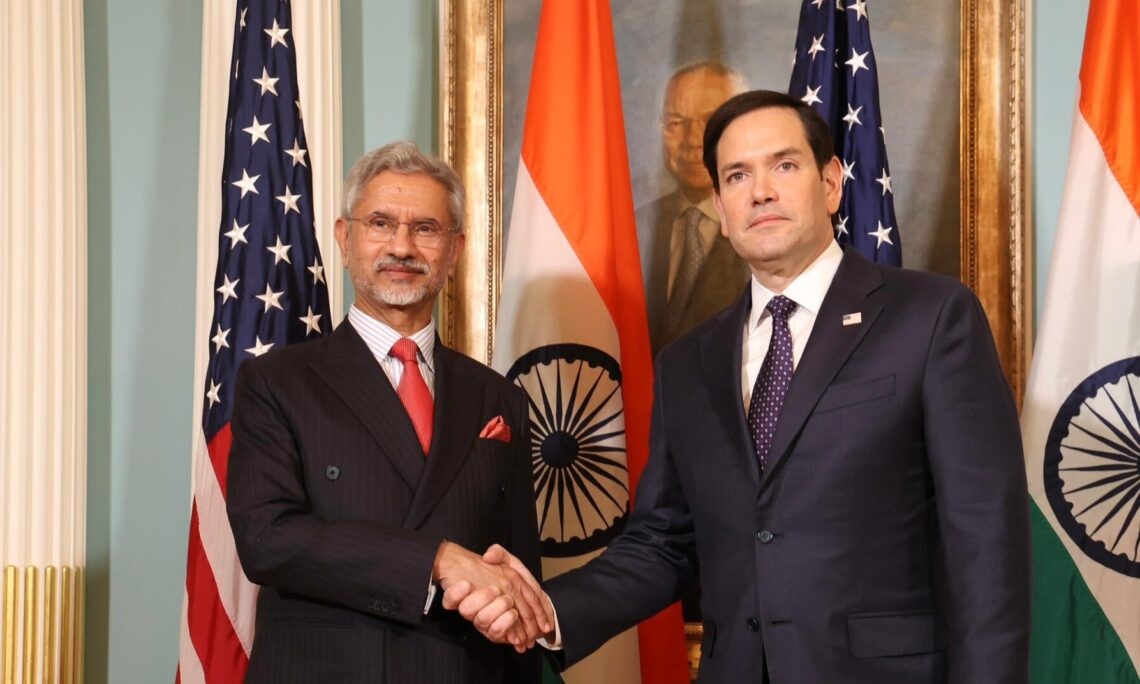
Source:U.S. Embassy & Consulates in India, “Secretary of State Marco Rubio’s Meeting with External Affairs Minister S. Jaishankar.” Official source.
The waiver President Donald Trump has granted from the “sanctions, restrictions and duties provided for in the Graham Act” brings India welcome relief on two fronts: energy security and trade. It may also remove one of the bigger obstacles to a bilateral trade agreement. The move came only days after Mr Trump announced an arrangement allowing Russia to sell diesel to the United States and to world markets, along with an ‘energy ceasefire’ between Ukraine and Russia.
These developments in the last two weeks set the context for the visit of US Secretary of State Marco Rubio and his meeting with External Affairs Minister Dr S Jaishankar in Mumbai on 20 October. While Indian officials have stated that the meeting will focus on “energy, trade and investment, defence, critical and emerging technologies,” Rubio said during a press conference in Uzbekistan, “We’re trying to finalise a trade deal with India right now. We’re very close to doing that. So that’s (the waiver and finalising the trade deal) one of the things we’ve taken into consideration.” The meeting is an opportunity to repair relations and prepare for a potentially successful visit by Prime Minister Modi to the US in December to attend the G20 summit and a bilateral meeting with President Trump.
The stakes for India are plain. It is the world’s third-largest consumer of crude oil and relies on imports for more than 88% of its needs. Russia has become its single largest supplier. In July, Russian crude touched a record 2.8 million barrels per day, roughly 53% of India’s total oil imports. Once the threat of 100% tariffs began to loom, Indian refiners steadily pivoted back towards the Gulf, and the UAE in particular. By August, Russia’s share had slipped to 44%, while the UAE’s jumped to 17.4% and Saudi Arabia’s reached 14%. The waiver lets India choose its suppliers once again on commercial grounds, without the spectre of sanctions hanging over every cargo.
There is a deep irony here. The waiver cuts against the very purpose of the Graham Act, a law that drew unprecedented bipartisan support from Democrats and Republicans in both the Senate and the House of Representatives. Its aim was straightforward: to starve Russia of the oil revenues that pay for its war in Ukraine. The ‘energy ceasefire’, which Ukrainian President Volodymyr Zelensky said came as news to him, would shield Russia’s oil installations from further damage and give Moscow time to repair them. The Act’s sponsors set out to squeeze Russia, while the President has now loosened the grip.
Would any of this give Mr Trump pause? Hardly. His Art of the Deal is built on extreme transactionalism, maximum pressure, constantly shifting positions and the creation of fresh leverage, along with a wanton disregard for international law and accepted diplomatic conduct. For him, consistency is not the priority; advantage is.
Mr Trump has long made a habit of keeping other countries off balance and guessing, whether they are allies or friends such as India. The more relevant question is whether he could ever have followed through on the proposed 100% tariffs against the five largest buyers of Russian crude, a group led by China and India. Probably not. But in his playbook, a threat does not need to be carried out to work. Its job is to wring out concessions that would otherwise be unreasonable to demand. Three factors explain why this particular threat was unlikely to materialise.
The first is China. India may be the largest importer of Russia’s seaborne crude, but China is the biggest buyer of Russian oil overall once pipeline supplies are counted. Yet sanctions on China did not come up during Mr Trump’s visit to Beijing in May, when he conferred an exclusive ‘G2’ status on the two countries, nor during President Xi Jinping’s visit to Washington in September, when Mr Trump rolled out the red carpet in every sense of the term. China has shown that it has both the means and the leverage to retaliate. Washington was therefore unlikely to apply Graham Act tariffs to Beijing. That made tariffs on India even less likely.

Source: kishjar? / Flickr, Moscow Oil Refinery, 3 July 2022. Source: Wikimedia Commons | CC BY 2.0.
The second is domestic politics. Diesel prices in the US hit an all-time high of $6.53 per gallon in late September. Any further escalation would only hurt Republican prospects in the midterm elections on 3 November. Pulling Russian crude off global markets through punitive tariffs would push diesel prices higher still. This electoral arithmetic must surely be weighing on Mr Trump’s mind.
The third is Mr Trump’s own reading of the war. In a recent outburst on Truth Social, he called President Zelensky a “modestly successful comedian” and accused him of “financial extraction, corruption, and the misuse of Western aid”. He appears to have drifted towards the Russian side in a conflict he regards as Europe’s war rather than America’s.
External Affairs Minister S. Jaishankar has often called out the West’s double standards, and on this question the US and Europe have marched in step. White House Trade Adviser Peter Navarro has publicly described India as “a global clearinghouse for Russian oil” and “a laundromat for the Kremlin.” Washington did not stop at rhetoric about “fueling Russia’s war machine.” It imposed a 25% penal tariff on India, which took overall tariffs on Indian goods to 50%. Now that the US itself is easing the pressure on Russian energy, the Europeans have gone strangely quiet. Under its 18th sanctions package, the EU Council froze the assets of Nayara Energy Limited, an India-based refiner with a Russian stake. Will Brussels take similar action against the US, which now meets its own definition of financing Russia’s war against Ukraine? Few would bet on it.
For India, the sword of Damocles has not gone away, since what has been waived can also be reinstated. Even so, New Delhi has played its hand well. It has not only escaped the tariff threat but also eased the way towards a trade deal, possibly in time for Prime Minister Narendra Modi’s visit in December.
On energy security, India now stands on firmer ground. It met the sudden supply shock from the West Asia crisis with composure and confidence. It widened its sourcing from 27 to 41 countries, avoided steep increases in the prices of petroleum products, kept LPG supplies flowing so that household kitchens were not disrupted, and kept fertiliser plants running to meet kharif demand.
The prolonged war has also forced Gulf producers to adapt. They have bypassed the Strait of Hormuz through pipelines and alternative routes, and brought exports back up to 84% of pre-war levels. The war may end and Hormuz may reopen, but the uncertainty around maritime choke points, and the high risk premiums that come with it, will not fade quickly. The world must prepare for that reality, just as it must prepare for arbitrary decisions by the world’s largest economy.
Ambassador Sunjay Sudhir is the former Ambassador of India to the United Arab Emirates and the Maldives, and currently Non-Resident Distinguished Fellow at Deccan Centre for International Relations (DCIR).
Disclaimer: The views and opinions expressed in the article are those of the author and do not necessarily reflect the official position of the Deccan Centre for International Relations.