
Advancing South India’s Global Agenda

China's Ethnic Unity Law Reaches Across the Himalayas: Venkatakrishnan Asuri
BackChina's Ethnic Unity Law Reaches Across the Himalayas: Venkatakrishnan Asuri
China's Ethnic Unity Law Reaches Across the Himalayas
Author: Venkatakrishnan Asuri
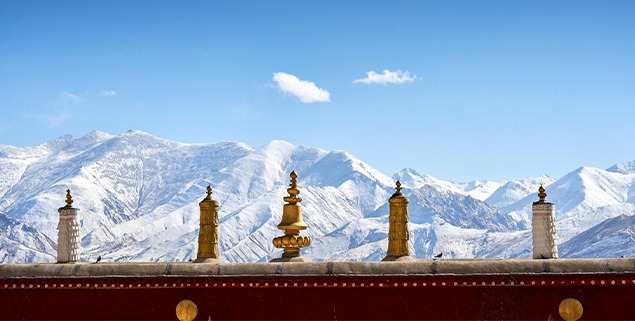
Source: Photo by Ricky Kwong from Pexels Official source.
Introduction
The Law of the People's Republic of China on Promoting Ethnic Unity and Progress (中华人民共和国民族团结进步促进法), adopted by the National People's Congress (NPC) on 12 March 2026 and in force since 1 July, does not once mention India, the Dalai Lama or the Line of Actual Control (LAC).[1] The absence of any reference to India has encouraged a reading of the law in New Delhi as a domestic instrument, concerned principally with the Party's assimilationist turn in ethnic policy and with the Tibetans and Uyghurs who live under it.
That reading, while understandable, leaves out three provisions which bear directly on Indian interests. Articles 10, 39 and 63 convert Beijing's established positions on Tibet and the Himalayan frontier into statutory obligations, and two of them are directed outward, towards the country which has hosted the Dalai Lama since 1959 and in which the institution charged with recognising his successor is located.
The Standing of the Statute
The weight that Beijing attaches to the text is evident from the manner of its passage. According to what was stated at the State Council Information Office briefing in June 2026, the Politburo, chaired by Xi Jinping, examined the draft in August 2025, the first bill to come before it in more than thirty years, and the law is the first in three decades to carry a preamble.[2] Its organising principle is the Party's formula of "forging a strong sense of community for the Chinese nation" (铸牢中华民族共同体意识), and much of its content is hortatory in character, as one would expect of what Chinese jurists describe as a promotional law (促进型立法). A law of this kind is seldom the basis of proceedings in a Chinese court, yet it furnishes the vocabulary in which Chinese diplomacy frames its objections, and since 1 July 2026 that vocabulary has carried the authority of a basic law adopted by the full NPC.
Article 10: External Interference as a Statutory Category
Article 10 provides that the cause of ethnic unity and progress shall not be subject to interference by external forces, and it opposes all acts of smearing, containment, infiltration and subversion directed at China on grounds of ethnicity, religion or human rights. The drafting record is instructive in this regard. The first-reading draft of September 2025 and the second-reading draft of December 2025 condemned such acts when undertaken "in the name of" (以……名义) those causes, while the bill placed before the NPC in March 2026 substituted the expression "under the pretext of" (以……借口).[3] The amendment is modest in length but deliberate in effect, since the earlier wording allowed for the possibility that a foreign government speaking about religion might genuinely be concerned with religion, whereas the final wording treats any such statement as cover for a different purpose.
India has already encountered this argument in its pre-statutory form. On 2 July 2025, the Dalai Lama affirmed that the Gaden Phodrang Trust, his office in Dharamsala, would alone be responsible for recognising his reincarnation.[4] After Union Minister Kiren Rijiju publicly endorsed that position, the Ministry of External Affairs (MEA) stated that the Government of India "does not take any position" on matters of faith and religion.[5] The clarification did not satisfy Beijing, and on 7 July the Chinese Foreign Ministry spokesperson, Mao Ning, said that China had lodged representations over the greetings extended by Indian leaders on the Dalai Lama's ninetieth birthday and called on India to stop using Xizang-related issues to interfere in China's internal affairs.[6] What was in 2025 the language of a spokesperson has since become the language of a basic law, and a position of neutrality on matters of faith is likely to carry limited weight against a statute which has already classified the succession as a question of foreign interference.
Article 63: Liability Beyond China's Borders
Article 63 carries the greater practical consequence for India. It provides that organisations and individuals outside the People's Republic of China who undermine ethnic unity and progress or create ethnic division (制造民族分裂) against China "shall be held legally liable in accordance with law," and it has been present since the first draft, in which it appeared as Article 61.[7] When foreign media characterised the clause as an assertion of long-arm jurisdiction (长臂管辖), the Vice Minister of Justice, Hu Weilie, told the State Council Information Office briefing on 24 June 2026 that it was a normal exercise of sovereign legislative power, that it would not affect academic or commercial exchanges, and that it elevated long-effective governance experience into a legal institution.[8] The last of these explanations is the most revealing, because it acknowledges that the article confers statutory authority on a practice which Chinese agencies have pursued against Tibetan and Uyghur activists abroad for some years.
The question of who falls within the reach of the article bears directly on India. Under the 2007 measures governing the reincarnation of living Buddhas, any recognition of a fifteenth Dalai Lama made without the golden urn procedure and the approval of the central government is unlawful,[9] and in the terms of the new law such a recognition would constitute an act of ethnic division. The trust charged with that recognition is registered and operates in India, as do the Central Tibetan Administration, the Tibetan settlements in Himachal Pradesh and Karnataka, and a considerable number of Indian officials, scholars and journalists who comment publicly on the succession.
The article nonetheless has evident limits, since it names neither a penalty nor a procedure, and Chinese authorities possess no means of enforcing it in Dharamsala. Its likely uses therefore lie elsewhere: as legal cover for entry bans and asset measures against named individuals, for which the Anti-Foreign Sanctions Law of 2021 already provides the machinery; as a point of reference in démarches to third countries that may host events connected with the succession; and, in bilateral discussions, as a means of presenting India's hosting of the succession process as a breach of Chinese law.
Articles 34 and 39: The Frontier as a Legal Obligation
Article 39, which concerns the frontier itself, requires the relevant departments of the State Council and county-level governments in border areas to pursue "prospering the border and enriching its people" (兴边富民) and "stabilising and consolidating the border" (稳边固边), to improve living conditions in border villages, and to develop a system of border towns, border trade and cross-border economic cooperation, while Article 34 assigns to ethnic regions a responsibility for safeguarding frontier security (边疆安全).[10] None of this is new as a matter of policy, for the 2023 white paper on Tibet describes the construction of well-off (小康) villages along the frontier and calls upon their residents to act as guardians of the sacred national territory,[11] and Li Hongzhong, Vice Chairman of the NPC Standing Committee, listed the securing and development of the border (安边固边兴边) among the bill's specific provisions when he introduced it in March 2026.[12] The change lies in the legal standing of these activities, since settlement and construction opposite Arunachal Pradesh and Sikkim have now become a statutory duty of Chinese county governments. India's Vibrant Villages Programme, approved by the Union Cabinet in February 2023 with an outlay of ₹4,800 crore for villages along the northern border,[13] remains a centrally sponsored scheme sustained through Cabinet decisions and budget cycles, so that an Indian instrument which can lapse with its financing period now faces a Chinese one which only the NPC can repeal.
Implications for India
The principal consequence of the law for India lies in the instruments it places at the disposal of Chinese diplomacy, since China's policy on Tibet is itself largely unchanged. Once Article 63 is cited in a bilateral setting, the succession will be presented to New Delhi as a matter of Chinese law, and India's long-standing position that activities on its soil, including the religious affairs of the Tibetan Buddhist community, are governed by Indian law alone will be tested more directly than at any time since the Dalai Lama's arrival in 1959. The formula of July 2025, under which the Government of India takes no position on matters of faith, was framed for a dispute about religion, whereas Articles 10 and 63 frame the same dispute as one of sovereignty and interference, and the distance between the two framings is likely to narrow the space that India has hitherto occupied through careful neutrality. On the frontier, the asymmetry between a statutory Chinese obligation and a scheme-based Indian programme suggests that the contest over settlement along the LAC will be shaped as much by the durability of each side's commitments as by the sums allocated to them.
Assessment
While the Ethnic Unity Law gives Beijing no power it can exercise in Dharamshala, it gives Chinese diplomacy a statute to cite. The record of the contacts between Beijing and the Dalai Lama's envoys bears this out, for in November 2008 Zhu Weiqun, then Executive Deputy Head of the United Front Work Department, rejected the Tibetan Memorandum on Genuine Autonomy as fundamentally incompatible with the Chinese Constitution.[14] The same method will, in all probability, be applied to the succession. When the question of the fifteenth Dalai Lama opens, India should expect to hear Articles 10 and 63 quoted in Chinese representations and in every bilateral meeting at which Tibet is raised. The Government of India has so far said that it takes no position on matters of faith. Beijing is unlikely to accept that answer, since under its own law the succession is a question of foreign interference and ethnic division, and not a question of faith.
------------------------------------------
1. 中华人民共和国民族团结进步促进法 (Law on Promoting Ethnic Unity and Progress), adopted 12 March 2026, effective 1 July 2026, Articles 10, 34, 39 and 63. Full text released by Xinhua, 13 March 2026: https://www.news.cn/politics/20260313/748e7a2db7764d82b4259c9e1256082e/c.html
2. Points made at the State Council Information Office briefing of 24 June 2026, as reported in "高'含宪量'立法,筑牢民族团结根基," The Paper (澎湃新闻), 24 June 2026: https://m.thepaper.cn/newsDetail_forward_33443446
3. NPC Standing Committee, draft Law on Promoting Ethnic Unity and Progress: first reading, September 2025, Articles 10 and 61: https://npcobserver.com/wp-content/uploads/2025/09/Law-on-Promoting-Ethnic-Unity-and-Progress-Draft.pdf; second reading, December 2025, Articles 10 and 61: https://npcobserver.com/wp-content/uploads/2025/12/Law-on-Promoting-Ethnic-Unity-and-Progress-2nd-Draft.pdf (official public-comment text; revisions introduced at the second reading are described at http://www.npc.gov.cn/npc/c2/c30834/202512/t20251222_450139.html); bill submitted to the Fourth Session of the 14th NPC, March 2026, Articles 10 and 63: https://npcobserver.com/wp-content/uploads/2026/03/Law-on-Promoting-Ethnic-Unity-and-Progress-2026.03-Draft.pdf.
4. Office of His Holiness the Dalai Lama, "Statement Affirming the Continuation of the Institution of Dalai Lama," 2 July 2025: https://www.dalailama.com/the-dalai-lama/biography-and-daily-life/reincarnation/statement-affirming-the-continuation-of-the-institution-of-dalai-lama-july-2-2025
5. MEA Official Spokesperson, response to media queries, 4 July 2025, as carried by All India Radio News: https://www.newsonair.gov.in/india-respects-freedom-of-religion-refrains-from-commenting-on-dalai-lama-institution-mea
6. Foreign Ministry Spokesperson Mao Ning, regular press conference, 7 July 2025, as reported by Global Times: https://www.globaltimes.cn/page/202507/1337798.shtml
7. Draft texts as cited in note 3; Article 61 of the first-reading draft, renumbered Article 63 in the enacted law.
8. State Council Information Office press conference on the Law on Promoting Ethnic Unity and Progress, 24 June 2026. Xinhua report: https://www.news.cn/politics/20260624/77bb9d53788d41aba766be5e0b2ecb11/c.html; remarks of Vice Minister Hu Weilie on Article 63, China News Service via 人民政协网: https://www.rmzxw.com.cn/c/2026-06-24/3937304.shtml
9. State Administration for Religious Affairs, 藏传佛教活佛转世管理办法 (Measures on the Management of the Reincarnation of Living Buddhas in Tibetan Buddhism), Order No. 5, adopted 13 July 2007, effective 1 September 2007, Articles 2, 5, 7, 8 and 11, State Council Gazette, no. 8 of 2008: http://www.gov.cn/gongbao/content/2008/content_923053.htm.
10. Law on Promoting Ethnic Unity and Progress, Articles 34 and 39; full text as cited in note 1.
11. State Council Information Office, 《新时代党的治藏方略的实践及其历史性成就》 (white paper), November 2023, section on 固边兴边 work, as published by the PRC Consulate General in Kolkata: https://kolkata.china-consulate.gov.cn/chn/zlgxw/202311/t20231110_11177901.htm
12. Li Hongzhong, 关于《中华人民共和国民族团结进步促进法(草案)》的说明, March 2026, National Ethnic Affairs Commission: https://www.neac.gov.cn/seac/xwzx/202603/1187361.shtml
13. Press Information Bureau, Union Cabinet approval of the Vibrant Villages Programme, 15 February 2023: https://www.pib.gov.in/PressReleasePage.aspx?PRID=1899446
14. "中央政府驳斥达赖'中间道路' 拒绝对主权问题做任何妥协," remarks of Zhu Weiqun, 10 November 2008, PRC Consulate General in New York: https://newyork.china-consulate.gov.cn/xw/200811/t20081111_4234571.htm
Venkatakrishnan Asuri is a final-year undergraduate student at the Indian Institute of Technology Madras and Research Officer at the Deccan Centre for International Relations. His research interests span China studies, India's neighbourhood, and South Asian security. His works have appeared in India Foundation, The Diplomatist and CNN-News18, covering subcontinental security, great power competition, and India's foreign policy choices.
Disclaimer: The views and opinions expressed in the article are those of the author and do not necessarily reflect the official position of the Deccan Centre for International Relations.