
Advancing South India’s Global Agenda

Issue Brief No (10): Beyond the Battlefield: The Saudi-Houthi Conflict and Global Economic Security
Author: Sairakshit Raghupathy
Back
Issue Brief No (10): Beyond the Battlefield: The Saudi-Houthi Conflict and Global Economic Security
Author: Sairakshit Raghupathy
Issue Brief No: 10
Beyond the Battlefield: The Saudi-Houthi Conflict and Global Economic Security
Author: Sairakshit Raghupathy
Introduction
The renewed Houthi attacks on Saudi Arabia have raised concerns over energy security and maritime trade. On October 13, 2026, a missile strikes damaged Saudi Aramco’s headquarters, highlighting the vulnerability of critical energy infrastructure. The escalation coincided with growing uncertainty in oil markets with Brent crude reaching $106.06 per barrel on October 14th 2026. For India, the implications extend beyond the immediate conflict. India’s crude oil import dependence reached 88.7% in FY 2025-26, while Saudi Arabia accounted for approximately 13.81% of its crude imports. Increases in import costs, freight charges, and supply-chain unpredictability could result from disruptions to maritime routes and energy infrastructure. This brings up a more general question: Can India's trade and energy diversification initiatives shield its economy from concurrent disruptions to marine connectivity and oil supplies?
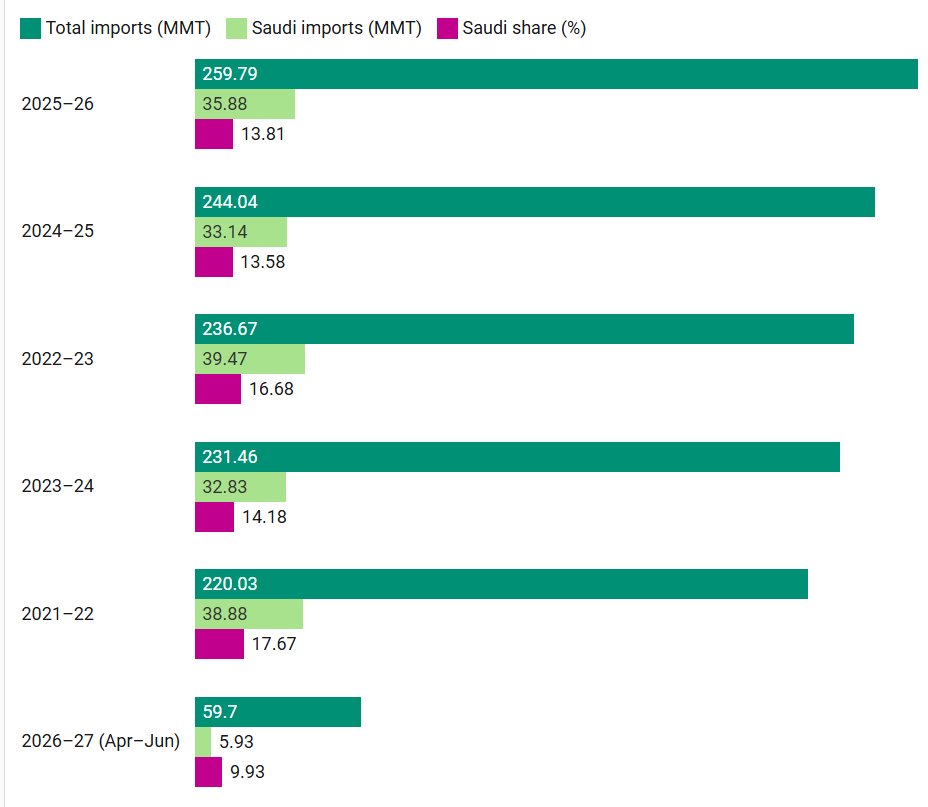
Fig 1. India’s Crude Oil Imports (in MMT)
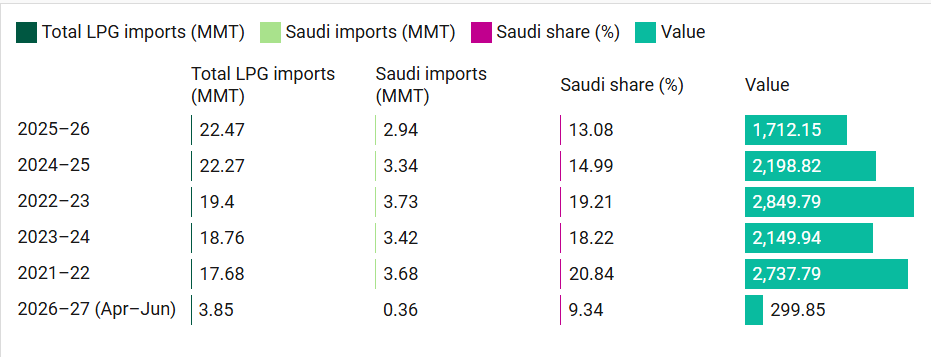
Fig 1.1. India’s LPG Imports (in MMT)
Why is it happening now
The Saudi – Houthi confrontation reflects Yemen’s unresolved political disputes and growing competition over strategic territory. The Houthis captured Sanaa in 2014, after President Abdrabbuh Mansur Hadi’s government lost control of the capital, prompting Saudi Arabia’s military intervention by the name Operation Decisive Storm in 2015. Although the UN mediated 2 month truce in April 2022 which reduced hostilities, it failed to produce a lasting settlement. A 78% decline in air and drone strikes during the truce’s first two months demonstrated the earlier de-escalation.
Fighting intensified in September 2026 when Houthi forces reportedly captured Mokha, near the Bab-el-Mandeb Strait. The offensive displaced 80,000 people and 11,442 households while Saudi backed forces prepared counter offensiveness involving potentially 100,000 Yemeni troops. Iranian military assistance reportedly supported Houthi advances, and promised more funding, weapons and senior officers to help them do so. Here the Houthis can increase security costs and political pressure without capturing Saudi territory. Their strategy combines territorial pressure with economic coercion, potentially strengthening their bargaining position while risking further escalation.
How Attacks affect Global Oil Prices
The threats to Saudi Arabia’s energy infrastructure affects global oil markets through both physical supply disruptions and uncertainty over future production. In September 2019, attacks on the Abqaiq processing facility and Khurais oil field temporarily disrupted 5.7 million barrels per day nearly 5% of global supply. Brent crude briefly surged almost 19% to $71 per barrel. However, Saudi Arabia restored the lost output.
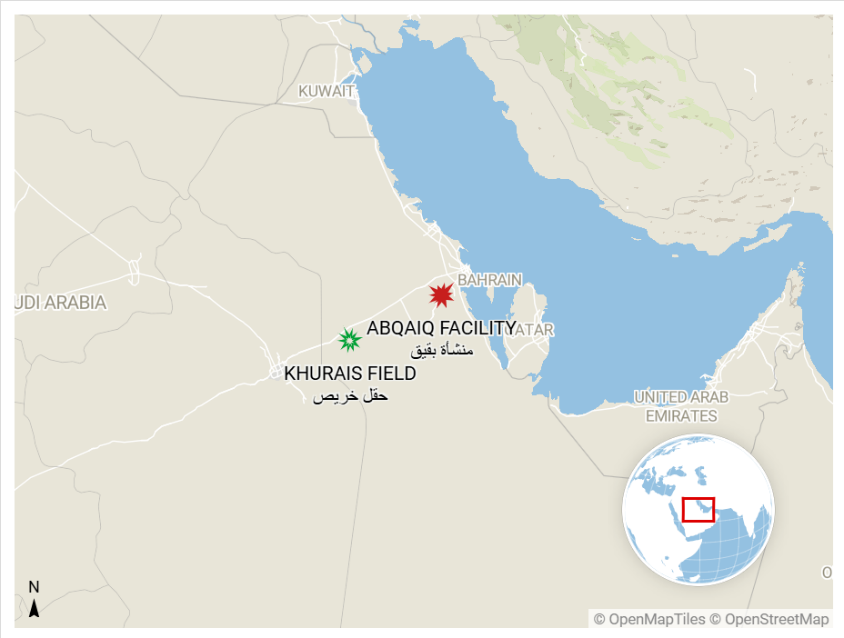
Fig 2. Saudi Energy Infrastructure Attack - 2019
Oil prices also respond to the risk of future shortages. Even when production continues, repeated attacks can increase uncertainty over export reliability, repair costs and shipping security. This creates a geopolitical risk premium, as treaders anticipate possible supply disruptions.
The October 2026 escalation illustrates this vulnerability. Crude oil prices rose from $102.83 barrel on Oct 01, 2026, to $116.27 on Oct 23, 2026, reflecting an overall increase of 13.07%. The lowest price was $100 on Oct 07, 2026. This indicates the trend in oil prices during October 2026. These increases reflected wider regional tensions, not Houthi attacks alone. For India, sustained high prices have increased freight rates by 130% and has pushed up transportation cost by disrupting shipments.
Red Sea Supply Chain & India’s Vulnerability
Beyond oil price volatility, the escalation threatens India’s maritime supply chains through the Red Sea, a major corridor connecting the Indian Ocean with European markets. Here, the Suez Canal plays an important role as 15% of global maritime trade normally passes through the Suez Canal.
India’s exposure is significant because Europe remains an important export market. India-EU merchandise trade reached $136.54 billion in fiscal 2024-25 with Indian exports accounting for $75.85 billion. Chemicals, machinery, textiles and metal products are among India’s major exports to the European Union (EU).
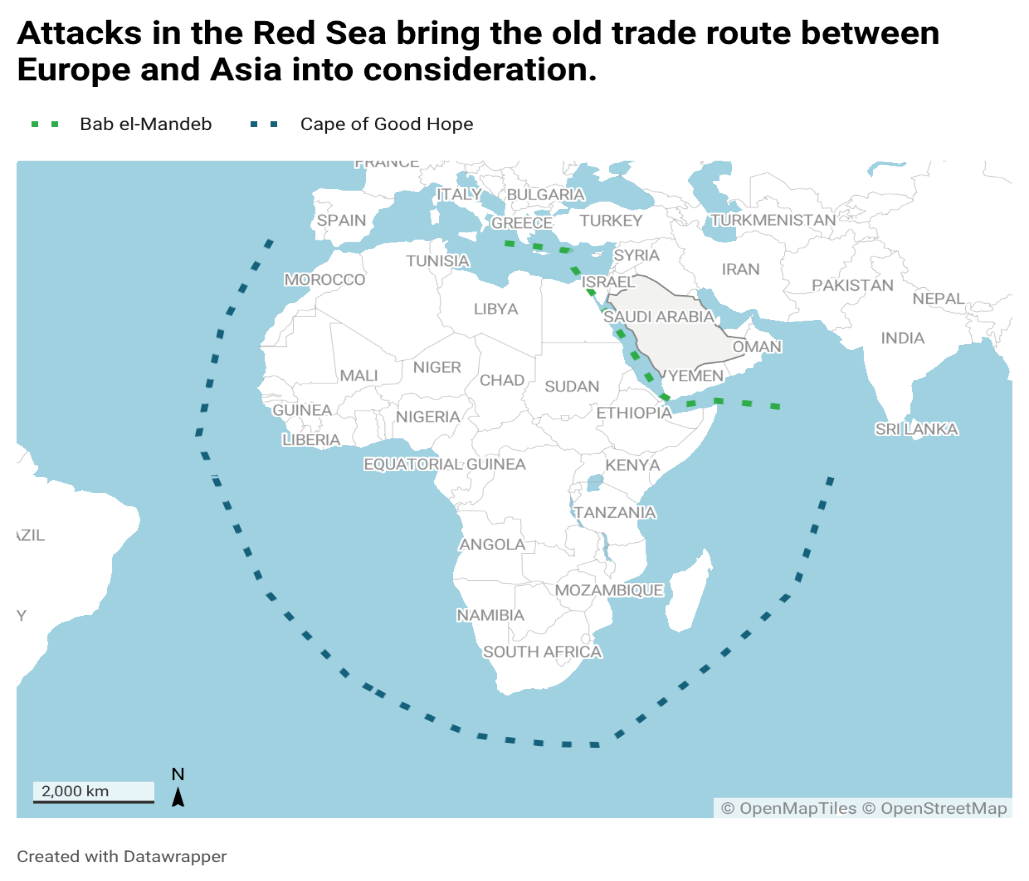
The Red Sea crisis has exposed India’s dependence on reliable shipping routes. In mid-2024, Suez Canal ship transits fell 70%, while arrivals around the Cape of Good Hope increased 89%. Longer routes raised global vessel ton-mile demand by 3% and container ship demand by 12%.
The impact also extends to petroleum trade. Since November 2023, an increase in attacks on ships passing in the Red Sea region has prompted merchants to explore an extended route through the Cape of Good Hope. This has not only extended delivery time by 15-20 days, but also significantly raised transit costs due to rising freight rates4 and insurance premiums.
India’s Economic Exposure: Fuel Prices, Inflation and Trade
The Red Sea disruption adds to India’s economic exposure through rising energy costs. India imported approximately 246 million metric tons of crude oil in fiscal 2025-26, while import dependence reached 88%. Russia, Iraq and the United Arab Emirates (UAE) remain important suppliers, but switching between them cannot fully protect India from higher international prices.
The financial consequences are significant. Based on annual imports 246 million metric tons, a $10‑per‑barrel increase in crude oil prices can trigger several macroeconomic effects that can affect the finances. The State Bank of India (SBI) uses the regression model to calculate exact financial impact due to oil spikes. The model is formulated as:
Yt = α + βOilPrice
The results of the regression model proved that for every $10 increase in crude oil prices, the "beta" translates to a 35 to 40 basis point rise in inflation, a 20 to 25 basis point slowdown in GDP growth, and a 36-basis point widening of the Current Account Deficit (CAD).
Recent data demonstrate the pressure. India's crude oil import bill surged 47% in September as the Indian basket price averaged $116.09 a barrel, while import volumes rose just 7% to 21.7 million tons. Higher crude costs can affect refraining, aviation, transportation and manufacturing. However, retail fuel prices also depend on taxes and pricing decisions. RBI research estimates that a 10% increase in global crude prices could raise headline inflation by a around 20 basis points.
India therefore faces a double burden: more expensive energy imports and higher freight costs for exports. Together, these pressures could weaken its trade balance and industrial competitiveness, making supply-chain resilience as important as supplier diversification.
India’s Diversification Strategy
India’s rising energy import costs and maritime risks underline the need to diversify suppliers, expand domestic exploration and strengthen energy infrastructure. Alternative crude supplies from Africa, the Americas and the Middle East can reduce dependence on individual countries. However, refinery compatibility, shipping costs and long-term contracts limit how quickly India can switch suppliers.
Overseas investments offer another option. As of march 2025, Indian public-sector companies held 45 oil and gas assets across 21 countries, worth US$ 40.6 billion. ONGC Videsh holds 16% interest in the Mozambique Rovuma Area-1 Offshore Project out of which 10% PI is held directly by ONGC Videsh and another 6% interest is held through its 60% shareholding in ‘Beas Rovuma Energy Mozambique Limited’ (“BREML”) while the remaining 40% shares in BREML are held by Oil India Limited (“OIL”). However, security concerns suspended construction in 2021, demonstrating that asset ownership does not guarantee immediate supplies. In South Sudan, ONGC Videsh holds 25% of Greater Pioneer Operating Company (GPOC), where cross-border infrastructure dependence creates additional risks.
Domestic exploration presents long-term opportunities. Government is taking sustained measures towards exploring and identifying crude oil and hydrocarbon reserves in the Andaman-Nicobar basin so that they can contribute to the country’s long term energy security and reduce import dependence. Exploratory efforts have resulted in the acquisition of 8,501-line kilometers of 2-Dimentional (2D) seismic data and 3,270 SKM of 3D seismic data in these blocks and three wells have been drilled in these blocks so far. Furthermore, under Open Acreage Licensing Policy (OALP) - X, four blocks with a total area of 47,058 sq. km have been offered in the Andaman Basin.
India also maintains 5.33 million metric tons of strategic petroleum storage capacity, with another 6.5 million approved for development. Such reserves provide temporary protection, while electric mobility and energy efficiency can reduce long-term petroleum demand. Ultimately, diversification must address supply-chain vulnerabilities. Greater reliance on African producers could replace Gulf dependence with exposure to different to political risks, export terminals and maritime routes. India’s priority should therefore be reliable supply, flexible infrastructure and reduced oil consumption.
Conclusion
The Saudi-Houthi conflict highlights India’s vulnerability to rising oil prices and maritime disruptions. While diversification can reduce dependence on individual suppliers, it cannot eliminate geopolitical risks. India should prioritize flexible oil procurement, stronger strategic reserves and alternative shipping routes, while investing in domestic exploration and reducing petroleum demand. The goal should be to build an energy system that can withstand global disruptions without placing additional pressure on the economy.
References
- 1 Jao, N. (2026, October 14). Oil prices gain on attacks in Saudi Arabia, Iran’s new tactics to target tankers. https://www.reuters.com/business/energy/oil-prices-climb-traders-weigh-saudi-supply-risk-russian-diesel-flow-2026-10-14/
- 2 Dispatch, I. (2026, October 20). Crude-oil imports and dependency. India by the Numbers. https://data.indiadispatch.com/economy/crude-oil-imports
- 3 Embassy of India, Riyadh, Saudi Arabia. (n.d.). India-Saudi Arabia: Economic and Commercial brief. https://www.eoiriyadh.gov.in/page/india-saudi-arabia-economic-and-commercial-brief/
- 4 Ayoub, A. (2026, October 21). Why Saudi Arabia helped create its worst Houthi nightmare. https://www.ynetnews.com/opinions-analysis/article/hjwjmab2fe#:~:text=*%20The%20decisive%20regional%20turning%20point%20came,superiority%20did%20not%20translate%20into%20political%20success.
- 5 Salim, F. (2022). Analysis of Saudi Arabia intervention in Decisive Storm operations in Yemen. Journal of International Studies on Energy Affairs, 3(1), 93–106. https://doi.org/10.51413/jisea.Vol3.Iss1.2022.93-106
- 6 UN News - Global perspective Human stories. (2022, April 1). UN welcomes announcement of two-month truce in Yemen. https://news.un.org/en/story/2022/04/1115392#:~:text=Under%20the%20truce%2C%20warring%20sides%20have%20accepted,and%20other%20governorates.%20*%20Possibility%20of%20renewal.
- 7 D’Hathuille, V. (2022, June 14). The UN-Mediated Truce in Yemen: Impacts of the First Two Months. https://acleddata.com/report/un-mediated-truce-yemen-impacts-first-two-months#:~:text=*%20Shelling%20across%20the%20main%20frontlines%20increased,and%20May%202022%2C%20their%20lethality%20decreased%20considerably.
- 8 AlTaher, N. (2026, September 12). About 80,000 people displaced in Yemen since September surge in hostilities began. https://www.thenationalnews.com/news/mena/2026/09/12/around-80000-people-displaced-in-yemen-since-september-surge-in-hostilities-began/#:~:text=ExplainerWhy%20fall%20of%20Yemen's%20historic%20coffee%20port,in%20Yemen.%20Share%20Article.%20Copy%20video%20link.
- 9 Singh, A. (2026, October 3). Saudi Arabia readies 100,000 Yemeni troops for Houthi assault: Can fragmented Yemeni forces retake Bab el-Mandeb? The Times of India. https://timesofindia.indiatimes.com/world/middle-east/saudi-arabia-readies-100000-yemeni-troops-for-houthi-assault-can-fragmented-yemeni-forces-retake-bab-el-mandeb/articleshow/134650886.cms
- 10 Greenley, H. L., Ratner, M., & Blanchard, C. M. (2019, October 1). Attacks on Saudi oil facilities: effects and responses. https://www.everycrsreport.com/files/20191001_IN11173_d116f59a58329ea5a27fcd13dc02f3d48b0ad87f.pdf
- 11 International Energy Agency. (2019, October 11). Oil market report. https://iea.blob.core.windows.net/assets/953b7442-bc56-467d-94ef-7cded75d0843/October_2019_OMR.pdf
- 12 Upreti, P. (Ed.). (2026, April 7). Geopolitical oil price risk and economic fluctuations. https://www.researchgate.net/publication/403565906_Geopolitical_Oil_Price_Risk_and_Economic_Fluctuations
- 13 Goodreturns. (n.d.). Crude oil price today (24th Oct, 2026): Crude oil rate, Brent futures & price chart. Goodreturn. https://www.goodreturns.in/crude-oil-price.html
- 14 Nagar, V. (2026, October 19). Bringing goods to India gets costlier as global freight rates surge 130% on Mideast conflict. NDTV Profit. https://www.ndtvprofit.com/world/bringing-goods-to-india-gets-costlier-as-global-freight-rates-surge-130-on-mideast-conflict-12207429#
- 15 Mahajan, T. (2026, October 21). Iran war impact: Indian Oil plans to reduce Middle East crude purchases under annual deals in FY28. The Times of India. https://timesofindia.indiatimes.com/business/india-business/iran-war-impact-indian-oil-plans-to-reduce-middle-east-crude-purchases-under-annual-deals-in-fy28/articleshow/135094647.cms
- 16 ENS Economic Bureau. (2024, January 16). Crisis can impact India as 80% of exports to Europe takes place via Red Sea: official. https://indianexpress.com/article/business/economy/crisis-can-impact-india-as-80-of-exports-to-europe-takes-place-via-red-sea-official-9110909/
- 17 Kamali, P., Verschuur, J., Sozzi, A., & Koepke, R. (2024, March 7). Red Sea attacks disrupt global trade. https://www.imf.org/en/Blogs/Articles/2024/03/07/Red-Sea-Attacks-Disrupt-Global-Trade
- 18 PIB Press Release. (2026, January 29). FREQUENTLY ASKED QUESTIONS INDIA AND EUROPEAN UNION FREE TRADE AGREEMENT [Press release]. https://www.pib.gov.in/PressReleaseDetail.aspx?
- 19 UNCTAD. (2024, October 22). Review of Maritime Transport 2024. https://unctad.org/system/files/official-document/rmt2024_en.pdf
- 20 Red Sea crisis to have differential impact across sectors. (n.d.). CRISIL. https://www.crisilratings.com/en/home/newsroom/press-releases/2024/01/red-sea-crisis-to-have-differential-impact-across-sectors.html
- 21 Reserve Bank of India. (n.d.). Production and imports of crude oil and petroleum products. https://dbie.rbihub.in/publications?table=real_sector.r148_production_and_imports_of_crude_oil_and_petroleum_products
- 22 Seli, Y. (2026, October 21). India’s oil dilemma: Balancing Russian imports amid US sanction threats. https://businessindia.co/magazine/focus/indias-oil-dilemma-balancing-russian-imports-amid-us-sanction-threats
- 23 Kumar, R. (2026, March 23). What a $10‑per‑barrel rise in crude oil prices means for inflation, loans, interest rates and EMIs. https://upstox.com/news/personal-finance/latest-updates/what-a-10-per-barrel-rise-in-crude-oil-prices-means-for-inflation-loans-and-your-daily-budget/article-190620/
- 24 Mathur, S. (2026, October 21). India’s crude oil import bill rises 47% to $15.4 billion in September. https://www.business-standard.com/industry/news/india-s-crude-oil-import-bill-rises-47-to-15-4-billion-in-september-126102101226_1.html
- 25 Kundu, S., Tewari, S., & Bhattacharyya, I. (2025, July 23). Revisiting the Oil Price and Inflation Nexus in India. https://www.rbi.org.in/Scripts/BS_ViewBulletin.aspx?Id=23516#:~:t
- 26 Siddiqui, H. (2026, April 14). India Eyes Africa To Secure Energy. https://stratnewsglobal.com/africa/india-eyes-africa-to-secure-energy/
- 27 The Economic Times. (2024, July 17). Indian Oil PSU’s have global presence with net investments of $40.6 billion, across 21 countries, says Hardeep Puri. https://economictimes.indiatimes.com/industry/energy/oil-gas/indian-oil-psus-have-global-presence-with-net-investments-of-40-6-billion-across-21-countries-says-hardeep-puri/articleshow/111799627.cms?from=mdr
- 28 ONGC Videsh Limited. (2019, February 26). Joint Venture Partners of Mozambique Rovuma Offshore Area 1 Seal more LNG sale and purchase agreements. https://ongcvidesh.com/joint-venture-partners-of-mozambique-rovuma-offshore-area-1-seal-more-lng-sale-and-purchase-agreements
- 29 Oil and Natural Gas Corporation Limited (ONGC). (2025, November 12). End of force majeure in Area 1 Mozambique LNG project. https://ongcindia.com/web/eng/detail?assetClassPK=78051636&assetEntry=78051641
- 30 ONGC Videsh Limited. (n.d.). Africa. https://ongcvidesh.com/assets/africa/
- 31 PIB Press Release. (2025, August 11). ANDAMAN OIL EXPLORATION [Press release]. https://www.pib.gov.in/PressReleasePage.aspx?PRID=2155111
- 32 Verma, N. (2026, August 3). India’s ONGC to reserve half of new oil storage for strategic reserves. https://www.reuters.com/business/energy/indias-ongc-reserve-half-new-oil-storage-strategic-reserves-2026-08-03/
Sairakshit Raghupathy is a Research Officer at the Deccan Centre for International Relations, specializing in geopolitics and energy security. His research interests span the Polar Regions, Central Asia, and North Africa, with a focus on the evolving geopolitical and strategic dynamics shaping these regions